What kind of lighting is best? (2 Viewers)

demax51

Sitting Out
Joined
Jun 30, 2023
Messages
44
Reaction score
97
Rewards
0
Location
Rochester, NY
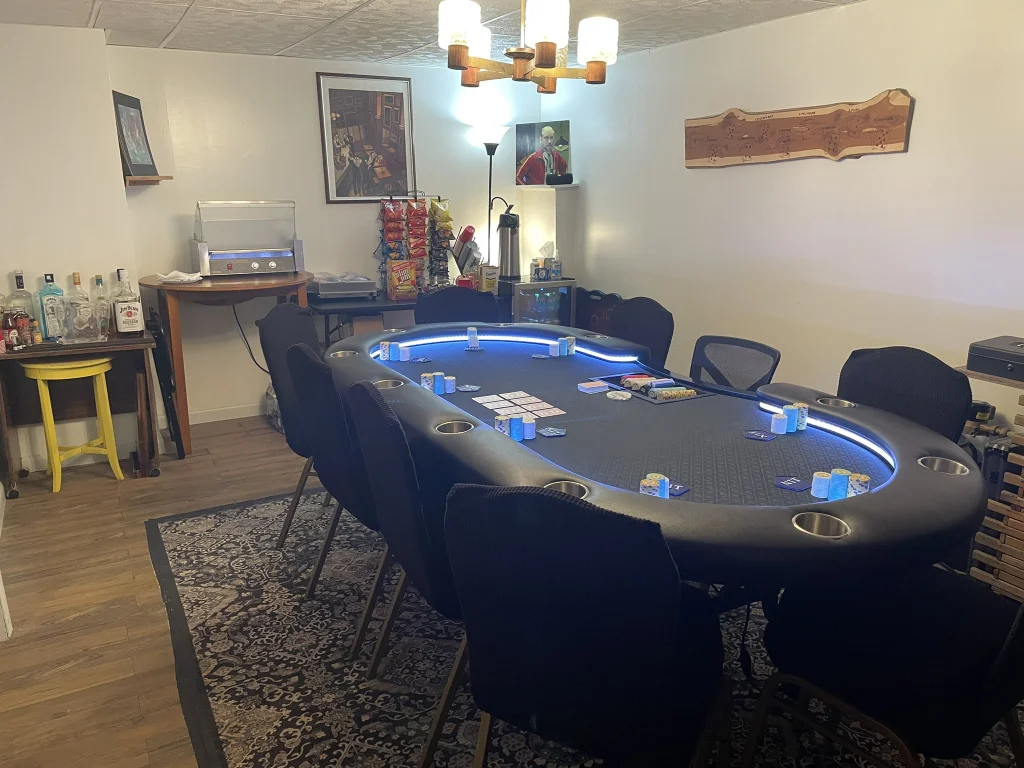
I recently asked for recommendations for my home game setup, and one of the recurring answers I got was better lighting. To be perfectly honest, I don't know shit about fuck when it comes to light fixtures or bulbs, so I figured I'd ask here. Any suggestions to up my lighting game? (Seriously, though, I know nothing about this, so please explain things as though I were a dipshit, because I am a dipshit.)

IMG_1473.webp
 
That looks to be brighter than my table. But at any rate, that looks to be a drop ceiling so you could look at track lighting from both sides, if they're pretty much looking for arena-style lighting. Another thing you could do is swap out that ceiling light and go with one that focuses more toward downlighing.
 
with the under-rail lighting, I can't imagine that players are having a problem with seeing their hole cards but it does look like the white chips are taking on a blue hue due to the rail lighting and that might cause issues if you can't tell if someone bet a blue or white chip from across the table. Otherwise, awesome looking poker room!!!
 
with the under-rail lighting, I can't imagine that players are having a problem with seeing their hole cards but it does look like the white chips are taking on a blue hue due to the rail lighting and that might cause issues if you can't tell if someone bet a blue or white chip from across the table. Otherwise, awesome looking poker room!!!
I think that might be more my shitty picture-taking skills, 'cause it's very clear when you're at the table. And thanks!

I think the feedback I was getting is more that my current setup just isn't very aesthetically pleasing (or even, like, might be a little too bright?) as opposed to there not being enough light.
 
...Another thing you could do is swap out that ceiling light and go with one that focuses more toward downlighing.
Yeah, I was thinking about that. Like the kind of light that'd be over a pool table, right?
 
Looks like most/all of your bulbs are those hyper-bright compact fluorescent bulbs. A fair amount of people don't like that type of light because it strains their eyes or whatever. That could be the issue. Hard to know without your crew being more specific about what about the lights they don't like.
 
Looks like most/all of your bulbs are those hyper-bright compact fluorescent bulbs. A fair amount of people don't like that type of light because it strains their eyes or whatever. That could be the issue. Hard to know without your crew being more specific about what about the lights they don't like.
Yeah, that might be. What exactly should I look for to get a "gentler" light? Or is there a bulb you could recommend? I can't overstate how little I know about this stuff.
 
I personally use LED canned lights throughout my poker room and theater. I have them divided into zones and connected to my whole house “smart home” system with Savant, which allows me to dial in the exact settings I want and then with the push of a single button, I can have the lights full blast (welcome setting), drawn down to like 5% (movie night) or just the cans above the tables brighter, with the background lighting turned down a bit to reduce eye strain (poker time). You can make as many custom settings as you like or manually change each zone to create the exact mood you’re after. LEDs are much softer on the eyes than halogen or fluorescent bulbs, they last like 20 years of non stop use and are pretty much free to leave on all day, if you so desire. Combine that with your table lighting and you’d be gold! But, the savant system as just a way to dim lights is maybe not worth the expense. I use it for whole home automation, so it was definitely worth it to me. I’ll also confess that I am also a dipshit when it comes to lights. I just have a couple electrician buddies who are regs in my game.

The cheaper/easier route would certainly be to use an overhead chandelier style light like this

https://www.amazon.com/SUZEPER-vict...poker+table+lights&qid=1769629667&sr=8-1&th=1

FWIW, if you use a whole home system like Savant, you can control the lighting via your phone, tablet, etc. I can even dial in the lighting on my poker tables if I want to change them. For example, during December, I ran a Xmas theme so all the tables looked “decorated” like the roof line of a house vs just a plain blue glow. Just a fun way to mix things up.
IMG_4150.webp
 
I personally use LED canned lights throughout my poker room and theater. I have them divided into zones and connected to my whole house “smart home” system with Savant, which allows me to dial in the exact settings I want and then with the push of a single button, I can have the lights full blast (welcome setting), drawn down to like 5% (movie night) or just the cans above the tables brighter, with the background lighting turned down a bit to reduce eye strain (poker time). You can make as many custom settings as you like or manually change each zone to create the exact mood you’re after. LEDs are much softer on the eyes than halogen or fluorescent bulbs, they last like 20 years of non stop use and are pretty much free to leave on all day, if you so desire. Combine that with your table lighting and you’d be gold! But, the savant system as just a way to dim lights is maybe not worth the expense. I use it for whole home automation, so it was definitely worth it to me. I’ll also confess that I am also a dipshit when it comes to lights. I just have a couple electrician buddies who are regs in my game.
That sounds sick! Way out of reach for me right now, but certainly something to aspire to. Thanks for taking the time to reply!
 
Yeah, that might be. What exactly should I look for to get a "gentler" light? Or is there a bulb you could recommend? I can't overstate how little I know about this stuff.
TBH I struggle with this too, since ordinary incandescent bulbs have become just about extinct. I feel like a sucker paying $8 for a damn light bulb that I don't even like, but what other options are there? Maybe LEDs with a lower brightness rating?
 
Want some light/chip pron? Here’s my current movie setting. 😂
View attachment 1628211
We enjoy movies more with some poker chip pron lol
Slide.


Here's a page that breaks down lumens and their "warmth". I struggled mightily when I was looking to set up the temperature of my house but charts like this really helped me understand what was going on.

Ultimately I think you're looking for something in the 2500-3500 range (probably most likely in the 3000 range). Anything in the 4000+ will feel too much like an office / hospital (ie too cold).
 
TBH I struggle with this too, since ordinary incandescent bulbs have become just about extinct. I feel like a sucker paying $8 for a damn light bulb that I don't even like, but what other options are there? Maybe LEDs with a lower brightness rating?
You can get LEDs in all kinds of different color temperatures from vintage amber (2000K and less) all the way up to cool white (6500K and higher).

Menards has the best selection around me, I've found. YMMV.
 
Here's a page that breaks down lumens and their "warmth". I struggled mightily when I was looking to set up the temperature of my house but charts like this really helped me understand what was going on.

Ultimately I think you're looking for something in the 2500-3500 range (probably most likely in the 3000 range). Anything in the 4000+ will feel too much like an office / hospital (ie too cold).
This is crazy helpful, thank you!
 
You can get LEDs in all kinds of different color temperatures from vintage amber (2000K and less) all the way up to cool white (6500K and higher).

Menards has the best selection around me, I've found. YMMV.
Really what I want is the old-school light bulbs to be available again. My problem is only about 5–10% light quality/color and 90–95% that I'm stuck paying more money for a substitute product I don't even want.
 
Hi!

To be perfectly honest, I also don't know shit about fuck when it comes to light fixtures or bulbs - just want to say that I love the Teddy KGB picture in the corner.
 
The lower the K value, the more yellow the light. The higher the K value, the bluer the light.

Think about the headlights in cars. The old incandescent lights were almost yellow, while the high intensity Halogen bulbs used in some cars now are almost blue. If you've had oncoming headlights shining in your face, you probably know which ones are easier on the eyes.

Same with LEDs. 2500-3000K give a soft "warm" light. 4500-5000 give a "cold" light. In a poker setting, warm is better (IMO)
 
We use Phillips Hue throughout our House. Allows for control of every individual lightbulb, full color spectrum.

Its very enjoyable for day to day life, and works great for the poker table too.
 
I prefer a simple suspended light that doesn’t cause glare but illuminates the table well.
 
We use Phillips Hue throughout our House. Allows for control of every individual lightbulb, full color spectrum.

Its very enjoyable for day to day life, and works great for the poker table too.
If you don’t mind my asking, what did it cost to get that set up?
 
We use something similar toe the Phillips Hue, The GE Cync. Roughly $9 per bulb. The app is free.

Allows full spectrum of light in every shade and brightness.
 
If you don’t mind my asking, what did it cost to get that set up?
Probably somewhere around $500 CAD over time but that is probably somewhere around 12 Bulbs upstairs with a flood lamp, and about another 10 in the basement as pot lights.

We started with a Bridge Kit and 3 bulbs, for ~$200 and then just added bulbs sporadically, generally on sales like Boxing Day / Black Friday, etc.

Love'em full control, programmable, can do cool stuff tying into AV.

https://www.philips-hue.com/en-ca/p...m-kg8SZoPUGuZGc1FLAn8GlXcilWq1PsaAlheEALw_wcB
 
I'd like to chime in with my two cents (which is probably more than it's worth!)... There are a lot of good comments above, so I'm really just adding to and expanding on what has already been mentioned.

(This post got really long and self-indulgent - my apologies for that. But who knows - it might be useful!!!)

I've been a lighting designer since the early 1990's, and the thing about lighting is that it is very site-specific. There are rules, certainly, but what works well for one situation might not work well in another. I once consulted with Woodworker's Warehouse because they wanted a pre-packaged lighting solution for the custom outdoor patios that they design. But all of their patios were, well - custom! We went over four or five or their custom patio designs, and I explained how I would light all of them in different ways. They're all different - and that means that the lighting for each would be different as well.

The big rule is this: Light what you want to light, and don't light what you don't want to light. That sounds obvious, I know... But look at Anthrax's photo up above - they are lighting the table surface, but the pool table shade lights are probably low enough that the light bulbs are not shining directly in the player's eyes. So they're lighting what they want to light (the table top), and not lighting what they don't want to light (the players' eyes). A light fixture that is designed to project light down onto a table top might be much more suitable, rather than an open chandelier that sprays light everywhere (of course, if that's what you like, then go for it!! You do you...) The same principle goes for good lighting built into the rail: It will shoot across the table like low-beam headlights - illuminating the cards, without causing glare in the eyes of a player sitting across the table.

Anyway, that's all abstract design theory. I really want to discuss some of the technical specifications for modern lighting, and how they might be important to you:

Correlated Color Temperature (CCT): As mentioned in other posts above, this can range from very "warm" and "amber" (or "soft") at the low end of the scale (say, 1800K), up to "cool" and "blue-ish" (or even "harsh") at the high end of the scale (around 5000K or 6000K). What quality of light do you imagine for your room? Warm and soft - cozy, perhaps? You might want to go with a lower CCT. Or do you like the bright and active appearance of some Texas card rooms? Then you might want to go with a higher CCT. Keep in mind that the most common range of CCT values is (generally) 2700K up to 5000K. A clear blue sky has a CCT of 10,000K, which is wonderful outside on a beautiful autumn day. But if you tried using 10,000K lighting in a poker room with no windows, you'd burn your retinas out, metaphorically speaking. Even 5000K can appear a bit harsh to some people - although other people love it.

A lot of big box stores have really good return policies, so you might go out and buy a few light bulbs in different color temperatures. Find a single brand of LED light bulb that is available in, say, 2700K, 3500K, 5000K - whatever. Find a nice range. Bring them home, and try each one in your poker room, at night. And see which one you like better. Finding a CCT that suits your own tastes and best suits your room can make a really big difference in how your places looks and even "feels". Even if you then return all of these lamps, you'll at least know what CCT suits you the best, and you can shop for other fixtures with that CCT in mind.

Color Rendering Index (CRI): (TL;DR - higher CRI is better. 90 CRI is good, 95 CRI is really good, and 97 or 98 CRI is really really good.) Remember when you were a kid, using a prism to split sunlight into a rainbow? That's what CRI describes - a complete rainbow with no colors missing would be CRI 100. Pure white light is made up of all the colors of the rainbow (technically, the complete range of frequencies of light, from deep red at one end to deep blue at the other end). But because the artificial light from LEDs or fluorescents is imperfect, some colors of the rainbow will actually be missing, or at least will be incomplete. If you were to use a prism to split the light from an LED or a fluorescent light source, you would see that some parts of the rainbow are actually missing. CRI is a measurement of how complete the rainbow is for a given light source. CRI of 100 is a theoretically complete rainbow of a standard incandescent source (I'm glossing over a lot of technical detail here).

Why is this important? Have you ever noticed that the colors inside your house at night are not nearly as bright and vibrant as they are outside on a clear and sunny day? The sun has a complete rainbow, so all the colors are represented, so your eyes can see all the bright colors. But if the light sources in your house are literally missing some colors of the rainbow, then those colors will be missing in your eyes' perception of objects that you're looking at. You can't see a color that isn't there. So you want your lights to have as complete a rainbow as possible. And the closer the CRI value is to 100, the more complete that rainbow will be.

The appearance of any colored object that you look at depends on the CRI of the light source. If you have a piece of artwork with many different colors in it, but your light source is missing the deep red portion of the rainbow (this is common with all but the highest CRI sources), then that piece of artwork will appear dull, or muted, as a lot of its reddish colors will not have the necessary color spectrum to reflect into your eyes. So, your artwork, your chips, your cards - everything will look better if your CRI is as high as you can get it. (I once designed the lighting for an art gallery, and the client paid a premium for the highest CRI light sources we could acquire - absolutely mandatory for something like that.)

This is the same reason why I don't like colored rail lights. Some tables have blue rail lights - which just means that all of the other colors of the rainbow are missing from that light. If your light source is only one color, then all the things it shines on will also appear to be very monochromatic: The colors of your chips will probably look weird, and might be difficult to differentiate. And if you're playing cards with a 4-color index, then the red, green and blue ink on the cards won't look the way you expect them to.

 
I'd like to chime in with my two cents (which is probably more than it's worth!)... There are a lot of good comments above, so I'm really just adding to and expanding on what has already been mentioned.

(This post got really long and self-indulgent - my apologies for that. But who knows - it might be useful!!!)

I've been a lighting designer since the early 1990's, and the thing about lighting is that it is very site-specific. There are rules, certainly, but what works well for one situation might not work well in another. I once consulted with Woodworker's Warehouse because they wanted a pre-packaged lighting solution for the custom outdoor patios that they design. But all of their patios were, well - custom! We went over four or five or their custom patio designs, and I explained how I would light all of them in different ways. They're all different - and that means that the lighting for each would be different as well.

The big rule is this: Light what you want to light, and don't light what you don't want to light. That sounds obvious, I know... But look at Anthrax's photo up above - they are lighting the table surface, but the pool table shade lights are probably low enough that the light bulbs are not shining directly in the player's eyes. So they're lighting what they want to light (the table top), and not lighting what they don't want to light (the players' eyes). A light fixture that is designed to project light down onto a table top might be much more suitable, rather than an open chandelier that sprays light everywhere (of course, if that's what you like, then go for it!! You do you...) The same principle goes for good lighting built into the rail: It will shoot across the table like low-beam headlights - illuminating the cards, without causing glare in the eyes of a player sitting across the table.

Anyway, that's all abstract design theory. I really want to discuss some of the technical specifications for modern lighting, and how they might be important to you:

Correlated Color Temperature (CCT): As mentioned in other posts above, this can range from very "warm" and "amber" (or "soft") at the low end of the scale (say, 1800K), up to "cool" and "blue-ish" (or even "harsh") at the high end of the scale (around 5000K or 6000K). What quality of light do you imagine for your room? Warm and soft - cozy, perhaps? You might want to go with a lower CCT. Or do you like the bright and active appearance of some Texas card rooms? Then you might want to go with a higher CCT. Keep in mind that the most common range of CCT values is (generally) 2700K up to 5000K. A clear blue sky has a CCT of 10,000K, which is wonderful outside on a beautiful autumn day. But if you tried using 10,000K lighting in a poker room with no windows, you'd burn your retinas out, metaphorically speaking. Even 5000K can appear a bit harsh to some people - although other people love it.

A lot of big box stores have really good return policies, so you might go out and buy a few light bulbs in different color temperatures. Find a single brand of LED light bulb that is available in, say, 2700K, 3500K, 5000K - whatever. Find a nice range. Bring them home, and try each one in your poker room, at night. And see which one you like better. Finding a CCT that suits your own tastes and best suits your room can make a really big difference in how your places looks and even "feels". Even if you then return all of these lamps, you'll at least know what CCT suits you the best, and you can shop for other fixtures with that CCT in mind.

Color Rendering Index (CRI): (TL;DR - higher CRI is better. 90 CRI is good, 95 CRI is really good, and 97 or 98 CRI is really really good.) Remember when you were a kid, using a prism to split sunlight into a rainbow? That's what CRI describes - a complete rainbow with no colors missing would be CRI 100. Pure white light is made up of all the colors of the rainbow (technically, the complete range of frequencies of light, from deep red at one end to deep blue at the other end). But because the artificial light from LEDs or fluorescents is imperfect, some colors of the rainbow will actually be missing, or at least will be incomplete. If you were to use a prism to split the light from an LED or a fluorescent light source, you would see that some parts of the rainbow are actually missing. CRI is a measurement of how complete the rainbow is for a given light source. CRI of 100 is a theoretically complete rainbow of a standard incandescent source (I'm glossing over a lot of technical detail here).

Why is this important? Have you ever noticed that the colors inside your house at night are not nearly as bright and vibrant as they are outside on a clear and sunny day? The sun has a complete rainbow, so all the colors are represented, so your eyes can see all the bright colors. But if the light sources in your house are literally missing some colors of the rainbow, then those colors will be missing in your eyes' perception of objects that you're looking at. You can't see a color that isn't there. So you want your lights to have as complete a rainbow as possible. And the closer the CRI value is to 100, the more complete that rainbow will be.

The appearance of any colored object that you look at depends on the CRI of the light source. If you have a piece of artwork with many different colors in it, but your light source is missing the deep red portion of the rainbow (this is common with all but the highest CRI sources), then that piece of artwork will appear dull, or muted, as a lot of its reddish colors will not have the necessary color spectrum to reflect into your eyes. So, your artwork, your chips, your cards - everything will look better if your CRI is as high as you can get it. (I once designed the lighting for an art gallery, and the client paid a premium for the highest CRI light sources we could acquire - absolutely mandatory for something like that.)

This is the same reason why I don't like colored rail lights. Some tables have blue rail lights - which just means that all of the other colors of the rainbow are missing from that light. If your light source is only one color, then all the things it shines on will also appear to be very monochromatic: The colors of your chips will probably look weird, and might be difficult to differentiate. And if you're playing cards with a 4-color index, then the red, green and blue ink on the cards won't look the way you expect them to.
AI version…still too many words for me.

You definitely know stuff…


This lighting designer (with 30+ years experience) says poker/game room lighting is very custom — no one-size-fits-all — but follow these key ideas:

### Main Rule
**Light what you want to see clearly (the table/cards/chips), and avoid lighting what you don't (like glare in players' eyes).**
- Use focused/downward lights (e.g., pendants, shades, or rail lights) instead of open chandeliers that spray light everywhere.
- This keeps the playing surface bright while preventing eye strain or glare for people sitting around the table.

### Two Big Technical Things to Care About (for LEDs/modern lights)

1. **Color Temperature (CCT — how "warm" or "cool" the light looks, measured in Kelvin/K)**
- **Warm/cozy** (2700K–3000K): Soft, inviting, like a lounge — great for long sessions, less harsh on eyes.
- **Neutral/bright** (3500K–4000K or so): Balanced, good visibility without feeling cold.
- **Cool/harsh** (5000K+): Very bright and active (like some casino vibes), but can feel glaring indoors.
**Tip**: Buy/test a few cheap LED bulbs in different K values (same brand), try them at night in your room, see what feels best. Return the ones you don't like.

2. **Color Rendering Index (CRI — how accurately colors look under the light)**
- Higher = better (aim for **90+**, ideally 95+).
- CRI 100 = perfect rainbow of colors (like sunlight), so reds, greens, blues on cards/chips/artwork look vibrant and true.
- Low CRI = missing colors → chips look dull/weird, reds muted, hard to tell suits apart.
- Avoid single-color rail lights (e.g., pure blue) — they mess up color perception even more.

**Bottom line**: Get good downward/focused lights, pick a warm-to-neutral CCT you like (many recommend 2700K–3500K for poker rooms), and prioritize high CRI (90+) LEDs. Your table, cards, and chips will look way better, eyes will stay comfortable longer, and the room will feel right.

Test bulbs first — it's cheap and makes a huge difference!
 

Create an account or login to comment

You must be a member in order to leave a comment

Create account

Create an account and join our community. It's easy!

Log in

Already have an account? Log in here.

Back
Top Bottom