What would you invest a million dollars in right now? (1 Viewer)

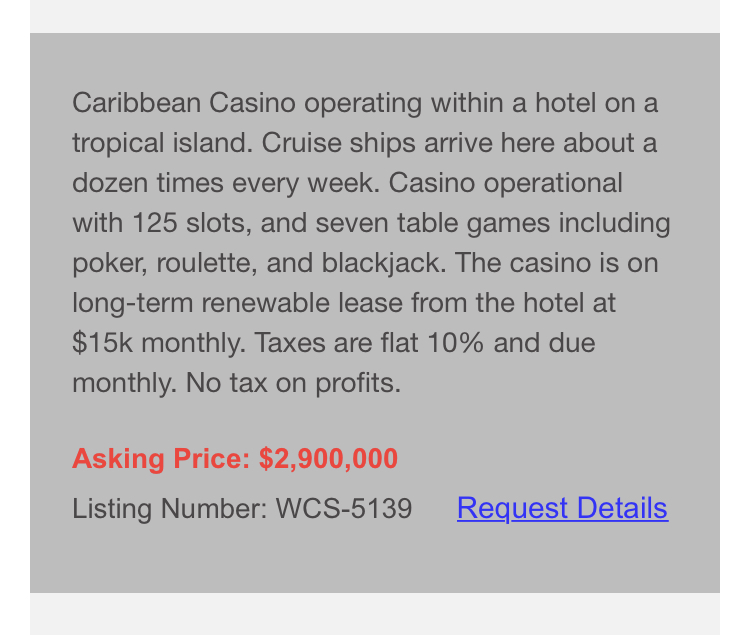
Okay 3x what you wanted but have I got a deal for you...
4946D63B-5D32-41DE-83D1-43DF245D2C3F.jpeg
 
Or this one? Look like you’ll need to buy some new chips. So unfortunate.

Maybe someone with a certain slot machine hobby might want to join?

Who’s in?

57BB0739-2E5A-4D74-B7E0-90CC7C4D59B7.jpeg
 
I would buy shares in Rural Electric Coops solar generation and storage facilities all over the US. Not because of these storms or anything but because it’s a long term gold mine. I’d focus on the ones that have storage capacity.
 
I would buy shares in Rural Electric Coops solar generation and storage facilities all over the US. Not because of these storms or anything but because it’s a long term gold mine. I’d focus on the ones that have storage capacity.
I see an increase in renewable-powered microgrids and battery storage.
 
Another thing I might do is offer Jim at The Chip Room a million dollars for his business AND contacts.
Pay Jim a consulting retainer to continue to broker the chips up front from the casino.
 
ETH
BTC
-done over 9 years ago, not a million dollars worth but hopefully I’m a millionaire from it in another 4 years

I’d say medical related but if a public option gets passed now, yah kiss your healthcare goodbye
So TESLA is up about 45% since January 2021
ETH is up about 350% plus and climbing before our end of 4 year cycle correction
Winning :)
 
Real estate. Fix n flips and/ or brrrr method.

I've had my realtor license about 5 years now. I've seen a lot of value come and go in the SD market. With a million cash I could probably find some motivated sellers.
 
There's a lot of speculation around BITCOIN, ETH and cryptocurrency in general; stocks being overvalued or undervalued; industries being ready for investment or not... so here's a question:

If you had a million dollars IN HAND today, and you couldn't use it to pay bills, pay off your home, nothing personal. but just invest for aggressive-ish growth: given the markets, political environment, and the state of the pandemic: where /how would you invest the money, and why?

(I'm using a million instead of the usual $1000 proxy because I want the movement to be meaningful not just in percentage gain, and allow for enough room for good strategy.)
Hard money real estate land and commercial loans. I’d do them at 12% interest only for two years secured by California real estate FIRST trust deeds at 50% LTV. 1 milly pays 10k interest a month. Easy month. Get 2 million in and thats 20k a month interest (the exact number my dad lives off) - easy money - No one defaults at 50% down and I WALK every properly myself. If they default I can often be heard yelling jackpot. I have one two months behind now. Law says 60, I give them 90. If it defaults I have a first of 250k against a appraisal of 800k. It’s 26 acres and 4 bedrooms with a 2 mile private driveway in a gorgeous area to name ONE example.

I’d also buy 50k in crypto diversified 50% big caps, 25% mid caps, and 25% small caps.

Then u would find me on the felt daily making even more.
 
I am a sucker for watches - I'd probably put half of it in some rare APs or FP Journes ... Many parallels to the art market, but lower barriers to enter and do transactions
 
While I understand the premise here is that the $1M can’t be used for anything else, that thought experiment only works in reality for extremely high net worth individuals (a/k/a the filthy rich)

For the rest of us, it is worth remembering: One can get lucky and hit on a few investments, but trying to significantly beat the market long-term is a bit of a fool’s errand.

Much like poker, one tends to only hear the stories of the few winners, and not the many losers.

Decide on personal goals/income needs and start with a standard 1/3rd - 1/3rd - 1/3rd division of assets. Invest as much of income as possible, and maintain a cash emergency fund. Prefer index funds to picking individual stocks. Never try to time the market.

The basics of this philosophy are sketched out at:

https://www.bogleheads.org/wiki/Bogleheads®_investment_philosophy

(Ignore the odd name; the site is named after the founder of Vanguard.)

FWIW, my dad was an economist whose speciality was gold markets (his institute was the WSJ’s go-to source for gold commentary.) He also devoted the last decade of his career to studying the entire stock market post-WWII, running long-term computer sims of various strategies.

He found the best one could do with equities was to invest small amounts in the top Dow 100 High Yield (dividend) stocks each month, blindly selling the purchases from 18 months previous every month.

Also, this allows you to not pay investment advisors, and to make all transactions through a low-fee firm like Schwab. Advisory and sales fees can easily wipe out any advantage one’s strategy otherwise has.

Boring but it will keep you slightly ahead of the overall market.
 
Last edited:
FWIW, my dad was an economist whose speciality was gold markets (his institute was the WSJ’s go-to source for gold commentary.) He also in the early 90s devoted the last decade of his career to studying the entire stock market post-WWII, running long-term computer sims of various strategies.

He found the best you could do with equities was to invest small amounts in the top 5-10 Dow 100 High Yield (dividend) stocks each month, and blindly selling the purchases from 18 months previous every month.
If only life was as simple now as it was post WWII. A lot has changed since then, they’ve invented computers and markets now exist that weren’t even possible back then. Plastics for example, have made possible cars and trucks in third world countries that would never have had enough metals, allowing trade and commerce on larger scale there than ever before. Markets have bloomed in many more nontraditional areas, and traditional companies with traditional investing strategies aren’t always going to be good performers. Average maybe, but not good. Average works better than nothing though!
 
If only life was as simple now as it was post WWII.

In 1945, barely 10,000 Americans had a television. Barely half had a refrigerator. Home ownership was under 50%. Only 40% of households had a car—almost all of them having just one car. And most people had never flown in an airplane.

So yes, life and markets were drastically different in 1945, even compared with 1965.

And the same could be said again in 1985. And 2005. That’s the point of doing a long-term analysis.

There will always be major technological changes, which make the next generation feel they are living in a totally different era.

We like flatter ourselves that we live in special times, not governed by the same fundamental patterns of behavior as our grandparents’ generation. So we don’t want to learn from the past.
 
I’m late in this one. My answer is Multi family housing (apartments). One million as a down payment on a $5,000,000 property. Passive income of $10,000 to $12,000 per month to start. Later with rent increases and 20 year loan payoff, it should yield $40,000 a month net. With housing price increases, the apartment market will be strong for as for as I can see.
 
In 1945, barely 10,000 Americans had a television. Barely half had a refrigerator. Home ownership was under 50%. Only 40% of households had a car—almost all of them having just one car. And most people had never flown in an airplane.

So yes, life and markets were drastically different in 1945, even compared with 1965.

And the same could be said again in 1985. And 2005. That’s the point of doing a long-term analysis.

There will always be major technological changes, which make the next generation feel they are living in a totally different era.

We like flatter ourselves that we live in special times, not governed by the same fundamental patterns of behavior as our grandparents’ generation. So we don’t want to learn from the past.
Invest in food crops and sewage treatment then.

Everything else you listed above the majority of the world lives TOTALLY without.
But the same could be said for money itself - the majority of the people in the world have none.

And that’s a long term trend since the beginning of people
 
I’m late in this one. My answer is Multi family housing (apartments). One million as a down payment on a $5,000,000 property. Passive income of $10,000 to $12,000 per month to start. Later with rent increases and 20 year loan payoff, it should yield $40,000 a month net. With housing price increases, the apartment market will be strong for as for as I can see.
Especially with the rise of socialism, big government, shrinking middle class
 
Invest in food crops and sewage treatment then.

Everything else you listed above the majority of the world lives TOTALLY without.
But the same could be said for money itself - the majority of the people in the world have none.

And that’s a long term trend since the beginning of people

Thanks for the newsflash—I was born in one if the poorest countries in the world (Malawi). My partner grew up in another country now torn by war (Syria).

But let’s face it, 98.5% of the members of PCF are “1st World” residents. No one who lacks a refrigerator is collecting poker chips.

So if the topic here is how to invest $1M or even $10K, that is de facto a discussion aimed at people with all those advantages.

Anyway, that wasn’t the point.

The point was that technological and social changes are common; but basic investment strategies (not based in insider info, fluke outcomes, or 1% of the 1% wealth) are pretty much stable across time.

People need to (a) beat the rake of investment advisors, and (b) play sound ranges with investments. Lots of people try to take high-variable shots instead, but we’ll only hear about the rare successes, not the countless busts.
 
We will always need more efficient means of generating and storing energy. So those entities that can create and maintain these will be the long term winners.
 
this isn’t really interesting unless it’s something that isn’t highly divisible since otherwise it’s just a “what do you currently invest in?” question with slight adjustments to portfolio mix to account for having more money.

My answer is I’d pay the licensing fees and software costs to open up a gambling site in Ontario, where it was recently legalized. Might end up doing it anyways but not needing investors would make things a lot easier. Software + fees isn’t close to a million obv but promotion is where it gets tricky. The cost is all up front for bettors that pay small dividends over the years.
 

Create an account or login to comment

You must be a member in order to leave a comment

Create account

Create an account and join our community. It's easy!

Log in

Already have an account? Log in here.

Back
Top Bottom