Cash Game Huge cash after dealing shift (1 Viewer)

10centguitar

Two Pair
Joined
Sep 11, 2014
Messages
394
Reaction score
220
Rewards
0
Location
Texas
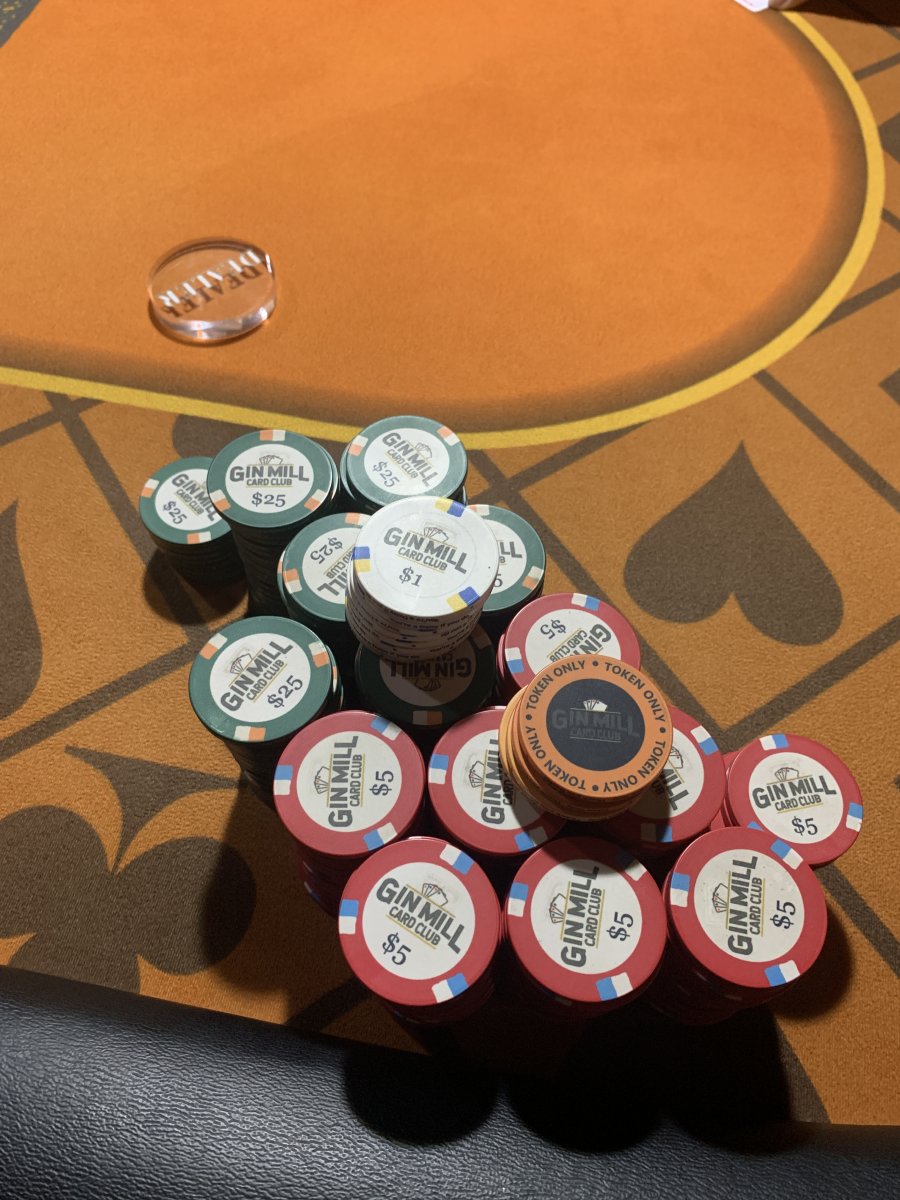
Just had to share!

Sat down at the $5-$15 OTB PLO cash game that was starting up after dealing a 4k guaranteed tourney.

Bought in for $250.

Most were putting only $5 on the button and lots of limpy calling stations.

Cashed $3908!

Pretty sure i wont being getting tokes from these guys for awhile!

9CFF1EBD-CB60-4BD8-AA9E-E40B6E9DE333.jpeg
 
That's why you shouldn't play where you deal, although you might not have that luxury in your area.
 
? Isn't there a stack of $1 chips there as well ?

Dunno if it's like Portland, but here dealers in card rooms are not allowed to take tips in chips, only cash. Prepaid tokens are probably a way to get around that.
 
We use $1 chips in play.
We used to run a lot of $1/$3 nlh but most players have requested $5 OTB nlh.

(OTB games in West Texas are really popular.)

Also we pull $2 per qualifying pot for the badbeat jackpot so thats why there is white chips in The game. But they only play in $5 increments.
 
Nice!! Very impressive cash! Give me some of that luck.

Tipping. No $1 chips on the table so every bet is more dealer friendly. Also no rake at Texas card rooms (seat fee or membership) so no point in $1 chips.
What do memberships normally run for cardrooms. I’m considering trying to open one in MS if the law allows it.
 
Nice!! Very impressive cash! Give me some of that luck.


What do memberships normally run for cardrooms. I’m considering trying to open one in MS if the law allows it.

There are 2 in my area, one charged $20/day to get in. The other charges $5 every 1/2 hour for cash games.

The first one tried to advertise itself as a social club that had other things to do like a pool table, dart board, shuffle board table, etc. But poker was its featured attraction. It was shut down when the casino put pressure on the local government. Dealers getting tipped is what was killed them.

The other one is much further South of the casino in another county and not as big so they seem to be safe for now.
 
Gotcha. I’m not sure where to search to find out if I can open one in MS. Or what hoops I’d have to jump through. I could put darts and stuff in and call it a social club lol

If anyone knows where to check for info pm me. I may start a thread about it.
 
Texas card houses are similar to what rhodeman said.

The room i work in charges $6 a half and a $10 daily.

Or you can pay a monthly $35 for membership which is what most people do.

Employees pay $5 for the monthly membership.

The time charge is astronomical to me.

I would rather play (with my style of play) in a raked game any day.
 
Texas card houses are similar to what rhodeman said.

The room i work in charges $6 a half and a $10 daily.

Or you can pay a monthly $35 for membership which is what most people do.

Employees pay $5 for the monthly membership.

The time charge is astronomical to me.

I would rather play (with my style of play) in a raked game any day.

I’ve always looked at rake vs time like this:

10% rake, $5max - my guess is most live games play at a rate of around 20-25 hands an hour. Let’s say 25 for easy math. Let’s also assume that the average rake per pot is $4. Again, just my estimate. So that’s $100 raked per hour.

$10/hr seat rental game(full ring)- $90/hour.

Assuming my numbers are correct, which they could very well be dead wrong, the seat rental fee model is better for the players.

Now, if a cardhouse is charging a seat rental, they will likely not have shufflers. It makes zero sense for them to speed the game up. So bring the average hands per hour down to 20, or even less if the dealers are green. With these numbers, rake is better.

TL;DR - Hands per hour is the most important factor in determining if seat rental or raked pots are better for you.
 
Play style also is a big factor. For very tight (nit) type players a rake is usually better. If you only win 1 hand per hour your rake is going to be $7 (local casino) $5 + $2 promo fund drop.

But if that same player was a at a seat fee table he would pay $8/per 1/2 hour so $16 for that hour while he waits for his 1 big hand to play that hour.

While the LAG player that is in a lot more pots, and wins 4 hands per hour is paying $28 in rake but the seat fee would only be $16.

***I am assuming max rake since it is PLO and the pots are rarely under $50 if ever.
 
Assuming 10% max 5 for pot rake (no JP), then in general I think time rake is better for players at $2/$5 NL/PL and higher. Though 2/5 is a bit on the cusp. And play style def matters. While it is possible to beat typical 5+2 pot rake at 1/2 and 1/3, playing LAG probably isn't the best idea. Winning just 2 pots in an hour is likely going to cost you the same as paying time unless those pots were under $40. I'm fairly nitty and even I have a hard time convincing myself that playing a 5+2 game is worth it below 2/5 NL unless the promotions are good.
 
@2jzMk3. Numbers are fairly solid. Penn Gaming uses automatic card shufflers. NLHE dealers at the local Hollywood slots deal between 25 and 30 hands a hour. The rake is $1 for every $10 in the pot, up to $60, plus an additional $1 for the BBJ when the pot hits $20. Average rake is $5 and change, roughly $150 per hour.

Another difference between the two models is the rake system relies heavily on re-buys and new players joining the table. You can watch the chip-stacks slowly shrink while playing $1/$3 at a table full of nits.

Seat fees (I assume) are paid out of pocket, which means chips are not being lost from play every hand.
 
if a cardhouse is charging a seat rental, they will likely not have shufflers. It makes zero sense for them to speed the game up.

That is true although dealers still have a tip incentive to get more hands in.
 
@2jzMk3. Numbers are fairly solid. Penn Gaming uses automatic card shufflers. NLHE dealers at the local Hollywood slots deal between 25 and 30 hands a hour. The rake is $1 for every $10 in the pot, up to $60, plus an additional $1 for the BBJ when the pot hits $20. Average rake is $5 and change, roughly $150 per hour.

Another difference between the two models is the rake system relies heavily on re-buys and new players joining the table. You can watch the chip-stacks slowly shrink while playing $1/$3 at a table full of nits.

Seat fees (I assume) are paid out of pocket, which means chips are not being lost from play every hand.
Not all are paid out of pocket. Unless it's changed, the Bike in LA has "collection" pots for their time rake.
 
The dealer I used last week still used 2 decks. He would shuffle the second deck while people were acting preflop. He would have it ready to go by the time he needed to pull in chips and deal the flop.

I was worried at first that he might mix up the decks, but it never happened.
 
The dealer I used last week still used 2 decks. He would shuffle the second deck while people were acting preflop. He would have it ready to go by the time he needed to pull in chips and deal the flop.

I was worried at first that he might mix up the decks, but it never happened.

Sometimes @Marc Hedrick will deal for us. The button shuffles the second deck while Marc deals and handles the pot. Works well for us. Sometimes @inca911 does this at the meet ups.
 
Sometimes @Marc Hedrick will deal for us. The button shuffles the second deck while Marc deals and handles the pot. Works well for us. Sometimes @inca911 does this at the meet ups.

When he asked for a second deck I thought about either shuffling the second deck for him or rotating it around, but decided against it. He is being paid tips (made about $270 for the game) so I can’t ask other people to tip and still shuffle for him. And I didn’t want to do it all night while still hosting and handling rebuys.

It went smoothly and he is dealing again for this weeks game.
 
Play style also is a big factor. For very tight (nit) type players a rake is usually better. If you only win 1 hand per hour your rake is going to be $7 (local casino) $5 + $2 promo fund drop.

But if that same player was a at a seat fee table he would pay $8/per 1/2 hour so $16 for that hour while he waits for his 1 big hand to play that hour.

While the LAG player that is in a lot more pots, and wins 4 hands per hour is paying $28 in rake but the seat fee would only be $16.

***I am assuming max rake since it is PLO and the pots are rarely under $50 if ever.
This
 
I’ve always looked at rake vs time like this:

10% rake, $5max - my guess is most live games play at a rate of around 20-25 hands an hour. Let’s say 25 for easy math. Let’s also assume that the average rake per pot is $4. Again, just my estimate. So that’s $100 raked per hour.

$10/hr seat rental game(full ring)- $90/hour.

Assuming my numbers are correct, which they could very well be dead wrong, the seat rental fee model is better for the players.

Now, if a cardhouse is charging a seat rental, they will likely not have shufflers. It makes zero sense for them to speed the game up. So bring the average hands per hour down to 20, or even less if the dealers are green. With these numbers, rake is better.

TL;DR - Hands per hour is the most important factor in determining if seat rental or raked pots are better for you.

Not a rant, just up after a long session.


From my experience the time/rake dollar per hour argument, although having many merits, has one major deficiency and that is the exclusion of the ‘player-style’ factor as someone else has mentioned.

As to the hourly-rate card room’s best interest in terms of hands per hour:

....“Now, if a cardhouse is charging a seat rental, they will likely not have shufflers. It makes zero sense for them to speed the game up.”

I will say that rooms want the most hands per hour they can get. They obviously want the most time paid as well. Which does mean they want to be running as many hours as possible but the quality of those hours and the frequency of those hours need to be considered as well.

The number of collective buy-ins are what cause action, and action is what keeps games running and rooms open.

Most buy-ins that fuel a game are from degens and big fish who hate slow games more than anyone. They crave fast action.

Slowing down games through fewer hands per hour to make more from time collected at a table is a losing proposition for a room.

A few points from a room’s long-term perspective:

•No one likes slow dealers (they will go elsewhere.)
•dealers need to make money (and fast good dealers find other gigs if action is too slow) more hands more income.

•players are highly annoyed paying time when they see fewer hands than they should be getting. And subsequently tip less

• a series of slow-paced games full of nits with little action (say a few days worth) can kill the action for weeks to come. (The regs will hunt elsewhere thus card rooms will give out more free time trying to get them back, all the while paying brushes and floors with the house taking less time paid.
• jackpots increase more slowly.

Good poker rooms know that fewer players means less time paid. Having full games is what brings players around. The players will know there is always a game that is bumping.

Lame rooms, where tables rarely make, bust frequently, or have shit action for extended periods of time don't fair well.

Simply put:

Having the best non-stop games in the surrounding area is what brings players with buyins, and that is directly influenced by the speed to which players can make a score or get even. Fewer hands per hour is good for no one in the long run.

 
Maybe you should play poker for a living instead of dealing haha
Not all are paid out of pocket. Unless it's changed, the Bike in LA has "collection" pots for their time rake.
@2jzMk3. Numbers are fairly solid. Penn Gaming uses automatic card shufflers. NLHE dealers at the local Hollywood slots deal between 25 and 30 hands a hour. The rake is $1 for every $10 in the pot, up to $60, plus an additional $1 for the BBJ when the pot hits $20. Average rake is $5 and change, roughly $150 per hour.

Another difference between the two models is the rake system relies heavily on re-buys and new players joining the table. You can watch the chip-stacks slowly shrink while playing $1/$3 at a table full of nits.

Seat fees (I assume) are paid out of pocket, which means chips are not being lost from play every hand.
In my room more often than not a player will buy a ton of them and then sell them at the table for chips when time is paid. Not the best but the money stays on the table.
Funny thing: the smart ones have found they can keep other players there longer if they play banker and make the time chips readily available. Ive even seen one pay the opponents time to keep a live one around.
 

Create an account or login to comment

You must be a member in order to leave a comment

Create account

Create an account and join our community. It's easy!

Log in

Already have an account? Log in here.

Back
Top Bottom