Thinking about getting a bike (1 Viewer)

A few points in no particular order:

- Trihonda has the most credibility here having taught bicycling classes etc

- Re weight loss (as in the OP). I am a huge fan of exercise, personally and as a physician. The benefits almost cannot be overstated. That said, weight loss it AT LEAST 80% diet, not excercise.

- Riding a road bike on the road is much, much less effort than a mountain bike over the same route. Significantly faster too.

- I wouldn't ride not clipped in, but it is a big hurdle for lots of folks. Depending on how often you have to stop for traffic, it can be a pain, too.

- Be safe. I have every light I can find on my bike to avoid being hit by a teenager on a cell phone.

- If you aren't running some sort of tubeless tire, you need the equipment to fix a flat AND know how to use it.

- When all is said and done, you really only have two end results: You buy a bike and end up rarely using it - or - you use it and end up getting a better bike. In neither case does it make much sense to buy a nice bike to start. I will again say Craig's List is your friend. Buy semi-wisely and you can sell it for the same $$ in six months when it is collecting dust or you want a better one (whichever happens).

L
 
There is about a 1.5-2 mile stretch where there is no shoulder. That part worries Me the most. It is hilly and people fly around there.

hm, don't like the sound of that.. could you find an alternate route?
 
Nope, that is the safest route.

Sounds like this isn't going to happen. Wife not on board.

This makes the most sense. No shoulder = no bike imo.

As mentioned weight loss is mostly achieved by changing eating patterns i.e. quantity and sugars.
 
Frankly, I'd be interested in hearing @Trihonda 's thoughts on getting a used cyclocross bike if one were available...

I like the idea of cyclocross bikes. I doubt a good cyclocross bike could be found in the OPs price point. But it's something to consider.

Again, the best results (for a new biker) would be found in a bike shop.

Buying a used bike brings about a host of challenges. I've purchased used bikes, but my knowledge of bike fit and bike mechanics make this a safer (but not without risk) option.

There's more to fit than just frame height. There are differences with top tube length, seat tube angle, stems length/rise, etc.. all these vary from manufacturer to manufacturer, and between models. Buying a used bike that is close in approximate fit, will get you close... but often times proper fitting will require additional purchases of stems, seats,, etc... and for a novice rider, you won't know any of this. For any long term riding of a particular bike (for a newer rider), it's worth it imho to just buy new. The shop often times will swap out stems, saddles, etc. free of charge, and they're there to help you navigate the process.

Buying used doesn't afford you the process of a lengthy test ride, and then an immediate test ride of another bike for comparison.. then an advocate to steer you into the right. Ike, then help you get fit on that bike, etc... the most likely outcome would involve a 5 minute test ride (not long enough to identify fit issues), after which you'll say, it felt ok, then buy the bike. Then have to go online and just like those YouTube gym instructional videos the OP disliked, he'll have to figure out how to fit himself on the bike...

My tale of bike shop employees comes from a lot of experience in bike shops, big bike shops. I've heard that attitude expressed from many different shop employees... that people who come in as I suggested, with a sincere interest in getting the right bike for the long term, often get the best advice. One shop employee told me that he'd had a novice rider come in to buy a bike, and because he was serious about it, the shop employee after working with the buyer for an hour, actually recommended visiting a competitor, because they didn't have the right bike in stock for him... he told me that had it been someone who was just gonna tool around in the parking lot for 2 minutes, he'd have just sold him whatever was in stock and fit him ok.

Again, if the OP were an experienced rider, I'd advocate at least considering used... in this instance, the service involved with buying new might be money well spent.

As to other aspects of riding (clipless pedals, accessories, cycling in traffic, etc...), once the OP snags a bike, I'm happy to post thoughts and some helpful video links. Some of my materials are online. :).
 
(Bike remorse may be worse than chip remorse: Sold my pristine red original Trek 1500 aluminum with full Shimano 600 group last week -- already missing it. :( Loved that bike more than any carbon fiber I've ever ridden...)

Rarely sold a bike... but the last one I sold was a beloved Trek OCLV 5500 bike. Purchased new for $2700 (on sale), rode it for 10 years (30,000 miles), and sold it for $1000. In the end, I had a very high race bike, and only paid $170 per year rental... :).

But no lie, 30,000 miles on a bicycle... it was time for that bike to find another home. Looked good as new, but I took care of it.

Here's the infamous 30,000 mile bike back in the day... sold it with stock wheels, not the carbon ones shown. (God, I wish I looked like that still)...

IMG_0062.JPG


Nope, that is the safest route.

Sounds like this isn't going to happen. Wife not on board.

Vehicular cycling can be done safely. I routinely ride in very crazy multi-lane traffic. Wouldn't advocate the novice doing that off the bat, but the course I teach involves my students doing exactly that on the final day.

Back roads? I wouldn't hesitate to advise someone to ride back roads, shoulder or not, assuming it's not a crazy dangerous stretch of highway with tons of mini-flower memorials along the roadside... proper lighting, visible clothing, and proper assertive (yet aware) riding can make communiting safer.
 
Thanks everyone for your input.

I'll revisit this when I'm not in a "F everything" mood ... most likely tomorrow. :-)
 
Cycling - I did exactly what you are thinking of doing regarding a bike about 12 years ago. Cycling is a great way to get the aerobic machine going and losing weight. When I worked in Scottsdale, AZ but lived 22 miles away, I was doing that ride 3 days a week. Then I moved to Holland and it was every day for 2 years (no car) with a trailer and 2 kids in the back..about the same distance you describe. If you do not require panniers, or can go very light with a small backpack I would recommend a road bike, not a hybrid. The reasoning is that you'll want to get in longer rides on the weekend and maybe being a roadie will sit well with you. Going the MTB route is fine too but you won't be covering that distance as quickly. Either way, it is important to get a bike with quality shifting components. I still believe that Shimano is your best bet for components for price and quality. If using a road bike, do not buy anything less than 105 level shifters and derailleurs. If going the MTB route, Deore level or better. You get what you pay for and anything less will just shift like crap after awhile and you'll just replace it anyway. You can go for bikes that are fitted with SRAM or Campagnolo (the nuts) components but I have no experience with SRAM and Campy is very pricey. To give a better idea of price, a good road bike with at least 105 level Shimano stuff should be somewhere in the neighborhood of 900 bucks. You can shop around and try to get a deal on this year's model when next year's hit the shops. Support your local bike shop. Happy riding.
 
Rarely sold a bike... but the last one I sold was a beloved Trek OCLV 5500 bike. Purchased new for $2700 (on sale), rode it for 10 years (30,000 miles), and sold it for $1000. In the end, I had a very high race bike, and only paid $170 per year rental... :).

But no lie, 30,000 miles on a bicycle... it was time for that bike to find another home. Looked good as new, but I took care of it.

Here's the infamous 30,000 mile bike back in the day... sold it with stock wheels, not the carbon ones shown. (God, I wish I looked like that still)...

View attachment 94134


Vehicular cycling can be done safely. I routinely ride in very crazy multi-lane traffic. Wouldn't advocate the novice doing that off the bat, but the course I teach involves my students doing exactly that on the final day.

Back roads? I wouldn't hesitate to advise someone to ride back roads, shoulder or not, assuming it's not a crazy dangerous stretch of highway with tons of mini-flower memorials along the roadside... proper lighting, visible clothing, and proper assertive (yet aware) riding can make communiting safer.

Wait a minute, isn't your custom set the "Fat tire poker club"????? Man, those tires are anything but fat.. Are you saving your racing design for the next set? ;)
 
I think some of the posts in the thread are bringing out the differences between folks who ride semi-pro, and those who bike less seriously (I'm not a long-distance rider). With due deference to the expertise of @Trihonda, with regard to bike fit, while it's important to have a bike with approximately the right size, I don't think it's quite as hard to adjust the fit of a bike as some of the posts make it sound.. Back in the day major bike manufacturers would produce bike frames in two, three or four sizes and those could be set up to fit basically everyone, with adjustment of the seat height and the handlebar height.

Of course, if you do buy used, you can always have the bike shop adjust the fit of your bike for a nominal fee.
 
Last edited:
@superchromix i agree, that for casual riding, a close fit can be achieved by taking a bike to a bike shop. I kid you not, pro level bike fits can cost upwards of $400. Some bike shops might provide a basic fit for nearly nothing, but probably not free, unless you buy the bike from them.

My main concern with the bike fit, was the op indicated this was a bike that would be ridden 13 miles every day (65 miles per week). Over time, any minor fit issues will present in major ways. Sore lower back, knee pain, numb wrists/hands, etc... had the OP indicated his riding would be limited to a short ride on weekends, around his neighborhood, I'd probably still probably recommend a bike shop (given his novice status), but fitment wouldn't be as big a concern.

I didn't mean to make the process sound so complicated. A bike shop will do a good job of uncomplicting the process. Getting the right bike from the start, makes fitting it much simpler. For instance, It's hard for a bike shop to change the length of the top tube, without swapping out stems. The right bike makes this change unnecessary.

My bike course, day one, involves fitting riders to general bikes they were issued, that don't always fit them the best. I get the challenges. An ok fit can be achieved with a bike frame that gets you "close".

But buying used is still something I'd steer the OP away from in this particular case... unless from a reputable used bike shop.

As to those who recommend road bikes? I agree the ideal commuter is based on road bike styling and geometry IMHO. Problem is the OPs price point might eliminate most good quality road bike options. I think hybrids tend to be marketed for the casual consumer and thus cheaper. Some of them are closer to road geometry, with flat handlebars (which I'd advocate for a novice rider commuting).

In 1991, I purchased a new Giant brand hybrid. It fit me well, and had quality components (it was $800 even back then). I still have this bike, and used it for year-round commuting each day for several years. My trip was 6-7 miles each way. My trip was 18-25 minutes each way, and was a great way to get some cardio mixed into my day. I contribute this commute to helping stay fit amidst a stint on night shift, when my diet was less than ideal...
 
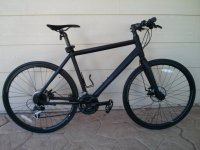
Based on my own experience, I would skip the mountain bike for commuting unless you also want to ride trails on the weekends and only want one bike. Otherwise, I'd recommend trying a hybrid first. I really like the combo of the more upright riding position with flat handlebars like a mountain bike with a light frame and skinny tires like a road bike. Here's my Cannondale Bad Boy before I added the rack for the panniers:

CZ-20150920160145501.jpg
 
So, for now, I bought a cheapo bike from Craigslist. I paid $100 for it, and figure I can do the ride a few times (one on the weekend, a few during the work week) If this is something that I defintely like and can work out the details, I will upgrade to a new bike.

We don't have any place to lock up bikes at work, so I have to work out that small detail. (I've been told people park them in front of the receptionist's window, but I would like to lock it up -- the new one if I go that route).

I figure, if it works out, I can most likely sell the bike for what I paid for it.

I should pick it up tonight, so I will keep you updated. Probably should update my will (read -- create a will) before the 1st ride :-)

Mark
 
Cool, congrats :)

Things to check when picking it up:
  • spin the wheels - watch where they pass the break pads. are the rims straight or do they wobble? it's ok if they wobble a bit, but they should not be rubbing the break pads.
  • while the wheel is still spinning, apply the brake. are the breaks firm, or is there a lot of play?
  • are the wheels rusted?
  • any broken / rusted spokes?
  • how is the rubber on the tires?
One of the most important things to check when picking up a used bike is the condition of the wheels. If the wheels are rusted / too wobbly, that's not something you can fix easily yourself.

With that said, anytime I've bought a used bike there are at least one or two things that need fixing, so it's normal to expect this. Before going out on the roads it would be a good plan to bring the bike around to your local bike shop for a once-over. They may give you a hard time about the condition of the bike, but as long as they check out the brakes and lube the gears/chain, that could be useful.

Post a pic when you've got one!
 
Ya congrats on the bike purchase. Can't fault the $100 find to gear up into biking.

Post pics and or specs that you know of. We can better guide you as to what you should be looking for.

Hiw old is the bike? Type? Brand?

In addition to the above advice, look at the chain and rear derailer. Rust on a chain is indicative of poor maintenance. A tad is ok, but it's completely rusted, it's probably been left/stored outside. Not good. That means all the cables and components will have corrosion on the internal parts you can't see.

Check for shifting. Does it run though all the gears? Poor shifting can easily be corrected. But really badly bent derailers will be a pain to fix.

I'll throw out an offer to FaceTime with you after you get the bike. I'm happy to walk through basics with you. Adjusting the shifters, brakes, lubing the bikes components.
 
Last edited:
Nice, and I hope the route works out for you! The part with no shoulder would make me nervous, but I hate riding with traffic. And seriously, get a helmet if you don't have one. I crashed a couple years ago and broke my helmet in a few places, but my head was OK except for maybe a slight concussion. The road rash was not fun either, but it heals. Head injuries are no joke.
 
Looks in good shape. Only one recommendation, mentioned before: before you do any more than test ride the bike, put pedals with old-fashioned toe clips on it. You don't even need to snug up the straps; just having your shoe tips in the clips will prevent whatever footwear you ride in from sliding forward or sideways off the pedals, which can be nasty.

Once you're used to them and riding regularly, you'll probably want to upgrade to clip-in biking shoes, which greatly increase your pedaling efficiency.

Have fun, and ride safe!
 
Nice, and I hope the route works out for you! The part with no shoulder would make me nervous, but I hate riding with traffic. And seriously, get a helmet if you don't have one. I crashed a couple years ago and broke my helmet in a few places, but my head was OK except for maybe a slight concussion. The road rash was not fun either, but it heals. Head injuries are no joke.
was 100% planning on getting a helmet. Going to get some sort of light/vest as well. I want to be visible.
 
I added these strapless toe clips to my bike: http://a.co/9XJS6xE

I'm sure they're not even half as good as clip-in shoes, but they are definitely better than nothing. I figured I'd try them for a week, and if I hated them I'd take them off. They've been on there ever since. My Nike tennis shoes were too bulky to fit in these clips, so I'm using some old Converse sneakers I had (really similar to the Adidas Samba indoor soccer shoes) for riding since the toe fits the clips better.
 
So, the Trek bike I tried yesterday did not have disc brakes. The Fuji I rode later did. I understand wet weather may impact the pads on the tire. Is there is any other reason to go disc over pads, or is it all relative?
 
So, the Trek bike I tried yesterday did not have disc brakes. The Fuji I rode later did. I understand wet weather may impact the pads on the tire. Is there is any other reason to go disc over pads, or is it all relative?

V brakes or disk, either are ok in this price point. I have very high end bikes without disk brakes. Never been an issue.
 
Looks in good shape. Only one recommendation, mentioned before: before you do any more than test ride the bike, put pedals with old-fashioned toe clips on it. You don't even need to snug up the straps; just having your shoe tips in the clips will prevent whatever footwear you ride in from sliding forward or sideways off the pedals, which can be nasty.

Once you're used to them and riding regularly, you'll probably want to upgrade to clip-in biking shoes, which greatly increase your pedaling efficiency.

Have fun, and ride safe!


OK, weighing in on pedal retention... I'm a huge advocate of clipless pedals.

Toe "clips" are those plastic toe cups, all roped in with the nylon strap/buckle thing. These are the most common.

Seen here: https://www.modernbike.com/product-2126179064

"Clip-less" pedals sounds misleading. It's actually a form of pedal retention where your foot/shoe actually "clips" into the pedal, lol. Weird, but I didn't name these stupid things.

Examples of clipless pedals: https://www.bing.com/images/search?...lipless+pedals&qpvt=clipless+pedals&FORM=IGRE

Pedal retention is HUGE for safety and pedaling efficiency. You get the benefit of having an up-pull (using your hamstrings as well as your quads). Using twice the muscles benefits your efficiency and fights fatigue and overuse injuries. That said, there are drawbacks to both.

Toe clips are easily available (pretty much free). I have a bunch of these just sitting around, but the cost to ship them to you probably costs more than the pedals themselves. Come to the MTTD, and I'll give you a set. These are relatively easy to use, and don't take a lot of time to get used to them. They're sometimes better than no pedal retention at all, but their is a minor safety drawback to be aware of. The straps snug up around your mid-foot, and if you somehow crash (sideways, endo, off the bike, etc..), your foot actually get trapped ON the pedal as the nylon strap cinches up tighter as your foot twists. This is when you WANT to separate yourself from the bike... Not have your foot locked onto a bike that is twisting all around (can we say, shredded knees).. When you have an OTB (over the bars) crash, this is when you want your foot locked into the pedals. You hit something (pothole, car, etc..) and are propelled forward, over the bars. If you are locked onto the bike's pedals with toe clips, these will allow you feet to come out easily in this motion. When you're going over the top, you actually WANT to be locked into the bike, and gain some enertia fighting weight of the rear of the bike, that has to rotate up (especially if you have paniers weighing the back down).

Clipless pedals are best IMHO. The are like ski bindings, that release when your foot twists, but don't release with there's backwards or upwards force applied. This means in the crash types listed above, you gain the benefits of release (when it's desired) and retention (when it helps hold you to the bike). I've seen folks without pedal retention hit a car-hood, then fly through the air 20 feet. I've seen folks with clipless pedals hit an immovable object, and they get thrown over the bars, and dumped right in front of the bike (due to the bike's weight/attachment slowing them down). Neither crash is desirable, but I can tell you which I'd prefer to be in...

Now, the drawbacks to clipless pedals. Much more expensive. This requires special shoes that you attach cleats to, and also special pedals that receive these cleats. Cheap pedals can be found for $40. Shoes around $50. These are bargain/bottom feeder quality products. The sky is the limit on what you could spend on quality pedals/shoes. I won't even mention how much I've spent on a single show/pedal setup for a race bike... The next drawback is the learning curve. These take a while to get used to. I'd recommend riding up and down your block, clipping in and out literally 200 times on each foot, before heading out on a legit ride. However, as others have said, the effort of getting in and out of clipless pedals becomes second nature and you'll never go back once you get a set. They're THAT much better.
 

Create an account or login to comment

You must be a member in order to leave a comment

Create account

Create an account and join our community. It's easy!

Log in

Already have an account? Log in here.

Back
Top Bottom