
Lessons from a first-year host (1 Viewer)

mdt11

3 of a Kind
Supporter
Joined
Aug 24, 2024
Messages
566
Reaction score
1,345
Rewards
270
Location
Brooklyn
Happy Holidays everyone. I’ve got some down time at the in-laws’ and have been reflecting on my first year of hosting games, so I thought I’d share here in case it helps anyone or sparks some discussion.

Thanks to the help of a lot of people here I was able to get a monthly game off the ground out of the living room in my apartment in Brooklyn starting in April. We play $1/$2 with an optional $5 and some nights it’s gotten relatively deep.

Your mileage may vary depending on your game, stakes, players, space, etc… but here are some of my takeaways, beyond the usual stuff discussed here, based on my experience hosting and playing in other home games, in no particular order.
IMG_0862.webp


1. Dealer “shifts” > deal on the button

If you don’t have a dedicated dealer, having trusted players take turns over a set amount of time is much more efficient than dealing on the button. During that set of time, one player is responsible for keeping the action going, instead of having to ask whose deal it is, did the button move, etc… and everyone else can relax. It can also help players feel more invested in the game.

2. Hosting, banking, dealing, playing. Pick three.

The first time I hosted I also dealt full-time, and I realized that was too much. You can’t do everything all night. If you’re using the dealing method mentioned above, you should feel comfortable excluding yourself from the rotation.

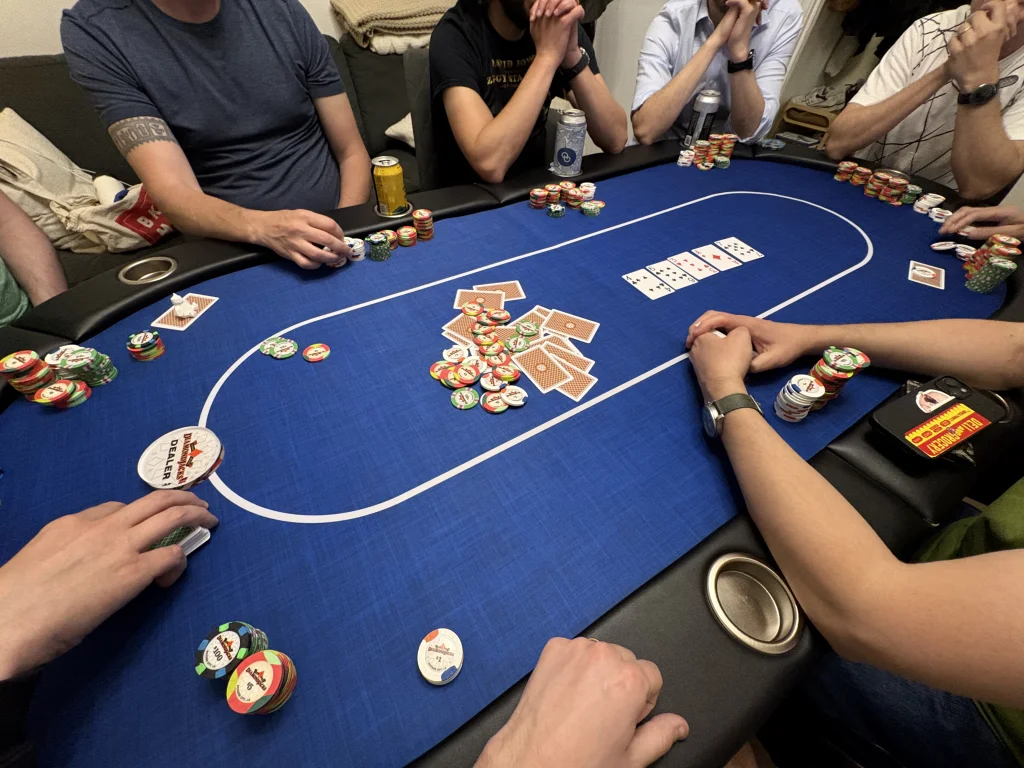
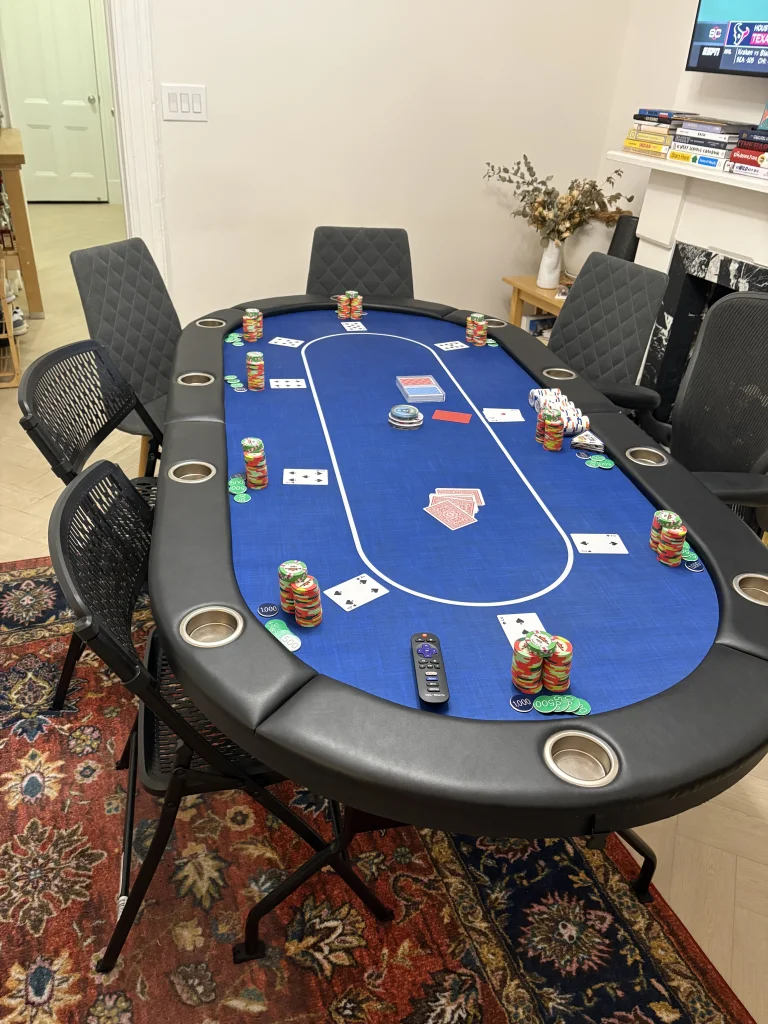
3. Start with all of the small denoms on the table. Only give rebuys in big chips.

For me, this means 100 whites + roughly two barrels of reds per player are in play from the jump. Once the game starts, I am giving out greens and blacks (and the occasional purple) only. Counting out small chips during play slows the game down and increases the chance of your count being off at the end of the night.
IMG_3092.webp


4. Communicate and enforce clear rules for buyins, straddles and any side games

Certain players will always want to push action or play exotic bomb pot variations, while others will not.

Neither are “right” or “wrong.” You can adjust your rules based on how you want a given game to play, and as long as you consistently enforce them, players can make their own decisions about whether and how to play.

Example: $1/$2 with an optional $5 straddle. $300 buyin/max. After 90 minutes, the max goes up to $500 or half the big stack. Double board PLO bomb pots on the hour and after a monotone or mono rank flop.

5. Your banking system needs a “double optin”

There are lots of discussions here about how to bank a game, especially in a digital-first world, but whatever you choose needs an acknowledgement from both parties of a transaction. I’ve detailed the system I use here, but this can also include pay-as-you-go (cash or digital) or a text ledger with both parties acknowledging a buyin or rebuy. Just say no to verbal rebuys with the host keeping a sheet.

6. Don’t be afraid to curate

There is a local pool of regulars that I play with and tried at first to give equal opportunity to for my games. But at some point I stopped caring about “fairness” and instead invite players based on who I enjoy spending time with, who is good for the game, etc… At the end of the day I’m inviting people into my home and won’t apologize for being picky about who comes over.

7. Find a simple, personal touch for an amenity

You don’t have to provide a full spread of food and drinks (though I know some of you are into that). But having something can go a long way.

I’ve started batching old fashioneds. They’re easy to make, and the players seem to enjoy them.

8. The game will always start 30 minutes after you tell people it will

If you want cards in the air at 8, tell people the game starts at 7:30.
 
Excellent list! I've been hosting for about a year or so in dedicated fashion. At a neutral location and not my home. Still, my takeaways largely overlap with yours.

Especially THIS:
2. Hosting, banking, dealing, playing. Pick three.
The first time I hosted I also dealt full-time, and I realized that was too much. You can’t do everything all night. If you’re using the dealing method mentioned above, you should feel comfortable excluding yourself from the rotation.

Fab point that I also learned the hard way. I gave up on dealing and got pro dealers who accept tips as payment. Even when it's one table and low stakes, it's hard to do everything. With multiple tables and higher stakes, it's not possible. I have to sit out several orbits in total just handling banking. And I had to make an autotallying spreadsheet to keep banking accurate too.

From my experience, another couple points I'll make that may resonate for some folks:

* If it's your equipment being used, feel free to protect it. What I mean is, if you bought and bring the cards, chips, and buttons, I think it's okay to request people take care of them. Not bending cards, not eating food and getting grease/stains/sauce all over the cards and chips (because who gets stuck cleaning everything? The host). People in my group understand to leave one of their hands free/clean or to just sit out an orbit, eat, then rejoin us.

* It's okay to insist on some hygiene. Some hosts may not care about this, and that's fine. It matters to me. I'm very open with my players that if you're being unhygienic, I'll ask you to go wash your hands. (If I see you sticking your finger in your mouth during a hand, licking fingers, etc.). I'm very friendly and take care of my players, so they know where it's coming from, and they largely appreciate it. But after the disgusting behaviors I've witnessed in casinos, I want an environment that's a bit classier, and I guess they value the game and company enough to comply. Some people say it's rude to point these things out, but first, I think there's a friendly enough way to broach such topics, and two, I say "It's my game." If someone doesn't like it, well, I'd rather they not join anyway (to your point about curating).
 
Last edited:
Great list here. I am likely going to adopt the Dealer Shifts approach for an extended trial.

Playing regularly with the same group; there are some players that should NOT deal. Ever game has a few that will focus on rate of play and manage the hand well.
 
Glad this is universal, and not limited to my group of goobers.
I think this is universal whether you have a poker game, sewing circle or book club.

I gave up on dealing and got pro dealers who accept tips as payment.
This is next on the list for my game, starting next weekend! I’m excited to have one less thing to worry about haha.

Not bending cards, not eating food and getting grease/stains/sauce all over the cards and chips (because who gets stuck cleaning everything? The host).
I don’t actively discourage eating during games but I make it difficult. I don’t provide food and don’t really have room for side tables. I try to keep food in the kitchen aside from some snacks. If you need to eat a full meal you can scarf it down in the other room.

Great list here. I am likely going to adopt the Dealer Shifts approach for an extended trial.

Playing regularly with the same group; there are some players that should NOT deal. Ever game has a few that will focus on rate of play and manage the hand well.
It’s a game-changer. And you’re absolutely right. Generally it’s 3 or 4 players who I trust to take a “shift.” Thankfully those are also the players who don’t really mind it if it keeps the game moving (and keeps the other apes from having to deal).
 
Do you mind elaborating more on this? In what ways do you curate your game/player pools?
I'll stab. Not all players are a good fit for your game, it's important to know what vibe you're going for and adjust accordingly. If you're looking to have a social game it might not be a deal breaker to have players who bring one buy in and that's in but for other games this could kill the action (personal pet peeve). Similarly if you enjoy a splashy game, having loose player or even calling stations are much better for the ecosystem than a table of nits. Lastly, spending multiple hours at a table, its nice to have people you find pleasurable to be around even outside of the gameplay. Whether that's being able to chat about similar interests, having basic hygiene, or having a pleasant demeanour when they get coolered are all things it's good to adjust your player pool to.
 
How long do you have the dedicated dealers deal for? An hour each? The issue with our game is we have 1-2 dedicated dealers but sometimes only one is there and its unfair to have one guy deal the whole time.
 
Do you mind elaborating more on this? In what ways do you curate your game/player pools?
Basically what @roughrabbit said.

I’ll kind of go through invites of tiers, prioritizing players who I enjoy hanging out with socially, who give decent action and who can behave themselves relatively well (we have an apartment with thin walls so I try to keep the noise to reasonable levels, which some players are incapable of doing).
 
I love this post so much, you have take a lot in this year.

Hope you don't mind me adding some remarks.

1. Dealer “shifts” > deal on the button

If you don’t have a dedicated dealer, having trusted players take turns over a set amount of time is much more efficient than dealing on the button. During that set of time, one player is responsible for keeping the action going, instead of having to ask whose deal it is, did the button move, etc… and everyone else can relax. It can also help players feel more invested in the game.

I am curious how you do this when it's time to change dealers. I would presume you would want a dedicated dealer in a center spot, do you just have the players switch and play on? do you wait for the big blind to be in a certain position?

This seems like a good middle ground between self-dealing and one dedicated dealer I had not considered.

2. Hosting, banking, dealing, playing. Pick three.

The first time I hosted I also dealt full-time, and I realized that was too much. You can’t do everything all night. If you’re using the dealing method mentioned above, you should feel comfortable excluding yourself from the rotation.

This is awesome advice. I typically don't deal full time so I focus on the other 3 tasks. On the exceptions when I do deal full time, it's usually late in a tournament after I have busted, so my playing and banking obligations are done.

If I am trying to do all four, I will at least have a couple candidates for backup dealers when a hosting duty should arise to spell me for a hand or two.

I hope @merkong doesn't mind the tag, but he was the first example I thought of when you brought up "pick three." He typically outsources the banking function to his SIL, and it works very smoothly. His SIL will also spell him from dealing if any hosting duty away form the table arises.

3. Start with all of the small denoms on the table. Only give rebuys in big chips.

For me, this means 100 whites + roughly two barrels of reds per player are in play from the jump. Once the game starts, I am giving out greens and blacks (and the occasional purple) only. Counting out small chips during play slows the game down and increases the chance of your count being off at the end of the night.

This is something pretty universal that PCFers have figured out, and it's great advice. The only small edge case is if someone buys in for an odd amount. Then you may have to make some odd change for small chips with a player. Not a huge deal and am only ever happens if someone has like exactly their last 28 dollars in their wallet. I can count this on one hand in my 20 years of hosting since college.

6. Don’t be afraid to curate

There is a local pool of regulars that I play with and tried at first to give equal opportunity to for my games. But at some point I stopped caring about “fairness” and instead invite players based on who I enjoy spending time with, who is good for the game, etc… At the end of the day I’m inviting people into my home and won’t apologize for being picky about who comes over.

This is something I need to get better at. Especially since I don't have the luxury of hosting on a regular cadence. Ideally what I think I need to do is identify 4-5 regulars and have them help me pick dates before I start pounding the text machine to my list of 30ish players. That way before I do the second step I know I have at least 5 confirms. This would help me ensure viable games before the mass texting.

8. The game will always start 30 minutes after you tell people it will

If you want cards in the air at 8, tell people the game starts at 7:30.

True, I tend to get better results hosting tournaments, and I am pretty clear we will deal when 5 show up, and I think it's a reasonable expectation that home game players be willing to play five handed.

We did have a situation in my last home game when 4 players were on time and a few others were late, so we played "single blind" for about 40 minutes to start. That was okay too.

Again great post, very exciting that you have a great game and are doing a good job.
 
Last edited:
I love this post so much, you have take a lot in this year.

Hope you don't mind me adding some remarks.
Thank you! The responses are welcomed and appreciated. I was hoping to generate some discussion as well, given that I’ve learned and adapted so much from folks here such as yourself.

I am curious how you do this when it's time to change dealers. I would presume you would want a dedicated dealer in a center spot, do you just have the players switch and play on? do you wait for the big blind to be in a certain position?
I will try to put players I know and trust to deal in a center spot, and otherwise will trade seats with them if someone wants to sub in. There’s no real method or madness to the timing. I wouldn’t mind if a dealer missed his or her big blind once to change seats.

At one game I volunteered to deal the first couple of hours until a game I wanted to watch started, at which point I passed off to someone else.

The only small edge case is if someone buys in for an odd amount. Then you may have to make some odd change for small chips with a player. Not a huge deal and am only ever happens if someone has like exactly their last 28 dollars in their wallet.
At our game/stakes I don’t think I’ve had someone try to add on in increments less than 100. And I’ll be flexible with the caps, so if you have, say, 521 and the cap is 700, you can add 200 more to keep it clean.

Ideally what I think I need to do is identify 4-5 regulars and have them help me pick dates before I start pounding the text machine to my list of 30ish players.
This is exactly what I’ve been doing, so that by the time you go out to the wider list, you aren’t trying to manage a bunch of peoples’ availabilities for different days, but saying “there will be a game on this day at this time. Are you in or out?”
 
Great advice here!

8. The game will always start 30 minutes after you tell people it will

If you want cards in the air at 8, tell people the game starts at 7:30.

I must be lucky because my game always starts on time +/- a couple minutes. I think my group of degens are just particularly eager to get the cards in the air. lol
 
Great advice here!


I must be lucky because my game always starts on time +/- a couple minutes. I think my group of degens are just particularly eager to get the cards in the air. lol

I think it also depends on how flexible you are as a host. Sometimes too flexible impacts that game negatively right?

I start the game on time every time and players know if they are late their stack is being blinded down. So, it is on them and they are responsible for that.
 
1. Dealer “shifts” > deal on the button

If you don’t have a dedicated dealer, having trusted players take turns over a set amount of time is much more efficient than dealing on the button. During that set of time, one player is responsible for keeping the action going, instead of having to ask whose deal it is, did the button move, etc… and everyone else can relax. It can also help players feel more invested in the game.


3. Start with all of the small denoms on the table. Only give rebuys in big chips.

For me, this means 100 whites + roughly two barrels of reds per player are in play from the jump. Once the game starts, I am giving out greens and blacks (and the occasional purple) only. Counting out small chips during play slows the game down and increases the chance of your count being off at the end of the night.

[

8. The game will always start 30 minutes after you tell people it will

If you want cards in the air at 8, tell people the game starts at 7:30.

I’ve been hosting for over 20 years and agree with all this …that’s applicable to me. The latest addition to my game in having my 14 year old son deal! My 16 and 14 year old sons got really into poker with their friends and my younger son asked to deal. I taught him a proper casino shuffle and how to manage the pot. He practiced dealing and shuffling almost every night for a week or so and is really good. People started tipping him and when he isn’t available due to sports etc they miss him dealing. He usually makes $60-80 in tips! That a $1/1 $120 game that usually goes 6-8 hours. Last game a drunk player helped boost that to $120! 😂

As for rebuys…100% for big chips. You will see a lot of massive stack in pics here because it’s a poker chip forum…but it’s makes little practical sense. The least amount of chips in play the best to cash people out. Also limit denominations in play. This is what casinos do. In a $1/3 game there are very few $1 chips in play. I often don’t have a $1 in my stack to tip the waitresses 😂

The starting late thing is true with a lot of things 😉
 
Certain players will always want to push action or play exotic bomb pot variations, while others will not.

True. I welcome suggestions, but in-game require that they get unanimous approval or we’re not doing it.

So if one guy doesn’t agree to a round of straddles, or doesn’t want to shift from NL to a round of PLO, it’s off.

If you don’t have a dedicated dealer, having trusted players take turns over a set amount of time is much more efficient than dealing on the button

I could see that being a good solution, if those few players are game to do it, and them always sitting in the same middle seats opposite each other doesn’t create stale game dynamics. Some of my players push to get certain seats they prefer, but I insist on random draws.
 
Curious as to why not? Our home game does not have dealers and we don't normally follow this rule. Just wondering as to the reasoning.
I've seen it happen so many times..........dealer thinks action is done and tosses a burn card into the muck, someone says hold on there is still action, action resumes for the betting round, then dealer incorrectly burns another card or the entire muck has to be counted to see if a card was burned yet or not for the upcoming street. If they are kept separate there is never any question if the correct amount of cards were burned. Play in any casino or watch any stream and the burn cards are always kept separate.
 
I’ll be adopting the dealer shift at my game. Never thought of it but makes a lot of sense.

Great write up here!
 
The latest addition to my game in having my 14 year old son deal! My 16 and 14 year old sons got really into poker with their friends and my younger son asked to deal.
I must have missed this comment originally but I think about this all the time if my wife and I are lucky enough to have kids! I would love to teach them and give them an opportunity to make some fun-money like this.
 
Dealer shift is a nice idea! Beware of ledgers, and remember: to buy a quarrel, lend money to a friend.
 
I must have missed this comment originally but I think about this all the time if my wife and I are lucky enough to have kids! I would love to teach them and give them an opportunity to make some fun-money like this.
Since I posted this, my younger son dealt half a game until we needed the seat when it went 10 handed. He is making about $10-15 and hour depending on how drink certain people get …and if those people are winning 😂. He now asks when the next game is and there’s older brother wants to get on the action. The argument now is with my wife. He needs to be in bed by midnight because now he has baseball winter workouts all weekend mornings.😂
 
If you want cards in the air at 8, tell people the game starts at 7:30.

I similarly advertise a "game time" but mentally schedule first deal for 30 minutes later. That gives people a chance to filter in, get drinks, catch up with each other. Cards go in the air on-time, always. The key thing is consistency because otherwise people will get comfortable running a little late because you run late because they run late... it's a vicious cycle.
 
I similarly advertise a "game time" but mentally schedule first deal for 30 minutes later.

My cash game actually gets off on time or pretty close to the announced time, because my players are eager to get down to it. People tend to arrive 10-15 minutes early so they can buy their chips, get settled in, grab a drink or a bite to eat before cards are in the air, shoot the breeze.

If I have 8 or 9 booked, usually 6-7 get there before gametime, one guy texts to let me know he’s running 15-20 minutes late, and one is a planned arrival for a couple hours into the game once he’s got his kids fed/home from practice etc. We start whenever there are 5-6 in the door.

When I held tournaments, it was initially more of a struggle to get the game off on time, but once I instituted a chunky on-time chip bonus, this stopped being an issue. The only problem was people speeding down the road when they were close to missing the cutoff time...
 
Great Post, how do you handle the length of play? Just finished playing in a game the other night that went very late. New to the scene so is this standard or are people usually able to play and use their buy ins in 3 - 4 hours?
 

Create an account or login to comment

You must be a member in order to leave a comment

Create account

Create an account and join our community. It's easy!

Log in

Already have an account? Log in here.

Back
Top Bottom