
Home Game Logistics (1 Viewer)

ianpoker

Sitting Out
Joined
Jun 4, 2025
Messages
28
Reaction score
48
Location
North Carolina
Hey everyone

Calling all home game enthusiasts...

I'm looking for some advice on how to operate as a host/dealer in the smoothest way possible for my home cash game. I've seen threads regarding this topic but am searching for more concentrated info on how to manage things like obtaining buy-in money from players smoothly, making sure only live chips are in play, managing staggered cashouts, dealing with distracted players (always on their phone and needs reminder when its their action) and overall just keeping everything organized whille also dealing the whole time. I've got all of the essentials now (table, cards, chips, chairs) so just need to focus on logistics.

My conflict here is that I want to manage the game to a high enough standard to keep pace of play up and seem organized but on the other hand I don't want to come off as a hardhead and make things too controlling. My goal is also to make this game consistent with players that know poker and share the same motivation that I have to keep the game running fast. (I can't tell you how many times I've been to games where we play 1 hand every 5 minutes and it ends up being a nightmare). However this is difficult as I'm hosting at my college house with 5 other housemates who are not serious about poker but always want to play so i would feel bad excluding them.

My game will be .25/.25 NL with $25 starting stacks & unlimited rebuys. As of now I plan on just giving each player a barrel of fracs and a barrell of $1s and just use $5s for rebuys. However, I have like 300 fracs and kinda prefer having as many fracs on the table as possible so I am open to other chip breakdowns.

I am also considering creating some sort of promo/high hand jackpot but would like to think outside the box and offer rewards that do not hurt too much financially.

I wan't my game to be seen as poker coming first, and socializing/drinking to come second (compliments greatly).

^^^Overall just looking to get in conversation with anyone who has experience hosting low stakes home games that I can bounce questions off of and take bits and pieces from everyone to run a fun but properly structured home game that will keep people coming back!
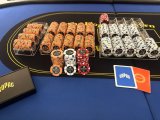
 

Attachments

  • IMG_0011.jpeg
    IMG_0011.jpeg
    174.5 KB · Views: 344
Don't overdo the fracs, especially if you're dealing. Stick to $3-5 worth and don't add anymore for rebuys. If you want a lot of chips on the table, get all the $1s on and then start going with $5s.

Keep all the buy-ins together and keep a change stack that's always the same ever night. For example, I always have a stack of 20 x $1s, 8x $5s and 4x $10s. So right off that's $100 in the bank. Don't even bother with quarters. You can round people down/up.

If someone's on the phone when it gets to them and they're slowing down the game, point to them with eye contact when it's their turn. If they do it again, tap the table in front of them with eye contact. If they do it again, put your fingers on their cards with eye contact. If they're dumb enough to make it to a fourth time, start to pull their cards towards the muck. If it gets past that, let them know if they can't pay attention they may not get invited back.
 
A few takeaways I have as a relatively new host after three home games where I encountered the same issues you described.

- Dealing, banking, playing. Pick two. I understand the want and need to run the game smoothly, but I found all three to just be too much. If you have a trusted player or two, see if they wouldn't mind dealing at least for the first two or three hours until things settle down. You can still enforce the rules and ensure a smooth game, but there will be interruptions whenever there are rebuys, topoffs, new players jumping in, etc...
- Starting stacks: Get as many fracs and 1s on the table as you can to start and only use 5s for rebuys. The first night I hosted my bank was off and I think the culprit was trying to complicate the rebuys with lots of different denoms. Getting all of your small chips out to start and sticking with bigger ones for rebuys will limit change-making, lower the opportunity for error on banking and keep things moving fast when a player needs more chips.
- I would skip the high hand/jackpot/promo stuff at least to start. Just play poker.
- While you want the poker to absolutely come first over drinking and socializing, your players may feel differently and it can hamper the game to have that imbalance. I've seen games fall flat when the host is being super serious or grumpy while players are trying to relax and have a good time (to the detriment of the "serious" players' win rates!). You can keep the game moving along smoothly without sacrificing the social aspect.
 
In the game I co host, we keep the deal between myself and the other host, each of us has a set of cards and shuffle while the other deals. If I or the other host is in a hand usually someone will over to shuffle on our behalf. This keeps the game from slowing down when having to pass the deal and alternate shufflers. Definitely second @buzzmonkey about the point, I actually point each time the action moves in a playful way. The players seem to like it and it keeps the action moving. If I can tell they know it's to them but are thinking, I drop the point, no reason for unnecessary pressure. Both of these things really increase the hands per hour compared to some of the other games I attend.
 
I host the same stakes.
Write down their name and how much they buy in for and number of rebuys/add-on amounts. Make a Total In and Total Out column. Make sure they match at the end of the game.
My game was right after work and we all pretty much agreed to end at a uniform time. Most people are patient and understand you want to be correct when cashing people out.
Have them count their chips first and then you count their chips.

I work with engineers so they liked to swap chips with each other to make whole $ amounts or get as close as possible. I could care less. I just wanted to know how much they were handing in to get cashed out and that is what I recorded. It was fun keeping track and the players wanted to know where they stood periodically.
 
Also, find the stakes/buy in people are willing to lose in an evening. Ask them!
If you raise stakes, it could kill your game in the long run. So make sure, as the host, you have the correct expectations for the dollar amount your table will see on any given night.
My guys were willing to spend $25 for the entire night to play some poker and they made that last 2-3 hours. I wasn’t expecting a Vegas style game. My $5 chips rarely saw the felt.
Send me DMs if you have direct questions.
 
Congrats on hosting. I use the same stakes, the same buy in as you do.
We self deal, dealer choice between Hold'em and Pineapple. We use cash only for buy in and rebuys.
I understand that using venmo, etransfers etc are more common today. Simply keep a buy in/rebuy ledger and settle at the end of the night. The downside of using lots of fracs is at cash out when many try to get rid of those in the last few hands so they don't have to count as many on cash out.
We set a time limit of the game as well, then go once around the table to finish the game.
I'm not sure how you do rebuys, but we only do the same as the buy in, but can rebuy a full $25 stack once the stack is $7 or less. For that reason, I have 5-6 rebuy stacks ready so no need to count chips on rebuys. I have chip tubes for the initial buy in and also rebuys.

We also pay out the high hand of the evening. Everyone puts in $2 , so it's worth $16 since the table sits 8.

Hope this gives you some ideas.
 
Last edited:
I've hosted raked games, I've dealt full-time for tips in underground games, and currently I host once a month .5/.5 that started off as .25/.5.

I like that you want to do .25/.25 it simplifies things.
Unless you have a cape and can fly or have 4 arms / hands, you can't bank and deal every hand, nor should you.

You will burn out on hosting if you try to self-deal, bank, and play, or self-deal all night and play. If you want a game that will last with self-deal, you need to focus on teaching people to deal properly. You also need to understand the concept of dealing behind, the importance of a cut card, and having different people shuffle and cut the deck.

As you likely won't have too many OMCs, learning to deal shouldn't be a big deal.


I have like 300 fracs and kinda prefer having as many fracs on the table as possible so I am open to other chip breakdowns.
Read this post
Spoiler: too many fracs will slow down the game, I ran my .25/.50 with 60 fracs, though I wouldn't advocate for that either. One rack is best.

I wan't my game to be seen as poker coming first, and socializing/drinking to come second
My game will be .25/.25 NL with $25 starting stacks & unlimited rebuys.
Not at these stakes, and that buy-in limit. I think what you want is for people to take the poker seriously; some will, some won't. Focus on enjoying the game. Which dealing, playing, and banking won't be able to happen.

One of the best things you can do is to keep the game going, Jimmy! its your action, Tom the bet is on you, James did you fold?
This will keep the focus on the game. Pass the deal, shuffle behind.
 
I've always strived for that perfectly run game. But I've learnt I can't do everything. The game runs better with a few key people helping out. But that means I've had to get used to those people making decisions. Even if they weren't quite what I believe should happen. And it turns out that's okay. Though, for the rare tricky/conflict situations the group does need to understand the director (me) has final say but also can be asked for help at any time. Balance.
 
Also, during cash in:
  • Spread the money out on the table so everyone can see. Count the money out loud.
  • Cut out the chips and count them out loud so the table can hear you.
  • Push the chips toward the player.
  • Have the player count the chips. If their count matches, put the cash into the till.
 
You've gotten great advice already and I'll just add one thing; consider rounding down to the nearest dollar at cash out. This greatly simplifies the process and gets rid of the need for loose change in the bank.

Take the money from the round-downs as a tip for the host, play a coin-flip for it, or what I do, put it into a progressive bad beat jackpot. ;)
 
Interesting turn of a phrase, I wonder how 'till' came to mean register?

till
  1. A drawer, small chest, or compartment for money, as in a store.
  2. A supply of money; a purse.
I've used the term since I was in retail in my teens. I suppose I picked it up there.
 
While writing down the buyins and cashouts can have its uses, ultimately your bank is your ledger.

By the time everyone is cashed out, it should be back to zero.

If it isn’t, that’s on you unfortunately. And having a written list won’t usually help sort out what went wrong.
 
Last edited:
Nothing to really add, but second/reinforce:

1. 2nd deck in the rotation. Everyone learns to deal: 1 to the right of the button shuffles, 1 to their right cuts the deck. We then put the cut card on top to show it’s both shuffled and cut. When the button moves, that deck slides over to the new button, they move the cut card to the base and start dealing straight away. Takes a few orbits for everyone to get used to it, but the game moves much much faster this way (also means more folk have to be paying attention since they’re either dealing/shuffling/cutting/in the blinds etc).
2. Get some justin racks (or just put out your buy in amounts and rebuy amounts ready nearby to grab). That way when folk arrive/buy in, you hand them the rack:
IMG_4219.jpeg

3. I went cashless, makes buy ins and cash outs super easy and fast. No payment, no chips (I let this slide and regretted it a bit since I then had to keep track and my game moves pretty fast).
4. Agree with the above, even if you’re not dealing, a simple friendly point and ‘action on you @RocAFella1 ‘ to remind the slowpokes.

GL!
 
Nothing to really add, but second/reinforce:

1. 2nd deck in the rotation. Everyone learns to deal: 1 to the right of the button shuffles, 1 to their right cuts the deck. We then put the cut card on top to show it’s both shuffled and cut. When the button moves, that deck slides over to the new button, they move the cut card to the base and start dealing straight away. Takes a few orbits for everyone to get used to it, but the game moves much much faster this way (also means more folk have to be paying attention since they’re either dealing/shuffling/cutting/in the blinds etc).
2. Get some justin racks (or just put out your buy in amounts and rebuy amounts ready nearby to grab). That way when folk arrive/buy in, you hand them the rack:
View attachment 1522543
3. I went cashless, makes buy ins and cash outs super easy and fast. No payment, no chips (I let this slide and regretted it a bit since I then had to keep track and my game moves pretty fast).
4. Agree with the above, even if you’re not dealing, a simple friendly point and ‘action on you @RocAFella1 ‘ to remind the slowpokes.

GL!

I rack up my buy-ins as well. Tip; if you put full barrels on each end you can then stack the racks. ;)
 
I'm reiterating alot of what others have said so call it a +1 on the dupes. Some just might be original.
  1. Like @4SUMERZ said. 10 tubes for starting stacks - Tubes > Racks. Easy 1 handed operation. If you already have justin racks you store two buyins per rack you split in half and leave separated for game start. - But tubes are better IMO.

  2. All of my smallest 2 denoms are on table in those 10 initial buy/rebuys. Every buy/rebuy after 10 is the 3rd largest denom and up. Agree with @mdt11

  3. When rebuying and you give them big chips - let them color up with neighbor. Don't sweat it when you give it to them. You have enough to do.

  4. You only need to keep track of who owes you money and not who buys in for what. - some disagreement on the thread here.

  5. Drawer is behind me but yes. Its a spin around instead of getting up to get chips. I'm not dealing so this is good enough for me. Dealer or Deputy counting rebuy and I'm getting chips. @PokerKS528 I have 1 drawer for all the tubes and the chips I need. 1 deep drawer is just envelopes (more on that next).

  6. I only count money on buy in, rebuy, add on. Put it in envelopes and seal it - writing amount. You are not only speeding up cash out by alot but mitigating an extra time that a mistake can be made. If someone buys in with small bills I'll note that on envelope too and not pass that one out whole but use it for the more granular cash outs.

  7. I only play, host & bank and burnout is substantial. "Can you get a different Tequila next week" with "Chips!" and "Did you order dinner yet? Can you have them add a side of hot sauce" All while the action comes your way.. Its a lot. Relatedly - in some ways I play better because I'm more selective on starting hands because I'm busy. In some ways I play worse because I don't know how people are playing. Who is tilting and chasing and pressing, etc. I'm always thinking about *the* game and not *my* game.

  8. Deputies - You're the boss. Let someone else count cash coming in if you're in a hand. I don't let anyone else near the chips. I will often ask a player to count bills, get the door, etc. etc. People are happy to help and usually if you trust someone enough to ask them they return in kind by being trustworthy. If I'm out of the room people can buy chips off my stack and leave the cash there but the deputy or the dealer would be reaching into my stack. I always sit next to the dealer to color up his tips to get small denoms back in play. Like @mdt11 said "pick two". I couldn't imagine dealing on top of what's going on. You need another guy or two to help out and keep it serious. Like @drdr said 'you can't do everything' If you are dealing and have a bro that is serious about poker too let them run the bank OR let the bank responsibility move around weekly. Give them a bank of chips at start of session and they handle everything and give you the bank of chips back at end of day.

  9. Chips... Too many chips, especially for inexperienced players will slow your game to a crawl. I make nice pretty pyramids with barrels of 20 and they're sort of in standard setups for me and I know what they're worth by sight and then can count the extras. New players will have dirty, disorganized messes.

    I thought I wanted MOAR chips. My first stacks were 44 chips in 20/20/9 stacks to get 200 of each small denom on the table. I even started a group buy interest thread for larger starting stack tubes so I could do a 49 chip tube or more if I wanted. I was wrong.

    If you have 2 guys in your game that always bet the smallest chips AND they're both winning meaning they always have small chips your NL/PL game will grind to a halt. Add in split bots, bomb pots, quartering, run it 3 times... all the times full stacks are counted down and even with professional dealers it's brutal. I've never played at a table where 150 of each denom wasn't enough and I'll say it - wasn't close to the right amount. For me 100 of the smallest denom is plenty and I could manage with less. For .25-.25 maybe 150 is better but more than that is just wasted time. Listen to the others and experiment... How low can you go? For me 20/20/4 became 15/13/11 for a few weeks and then 10/18/10 and it was great. 10/14/11 would probably be even better.

  10. @Kam - I know people that settle in crypto. How do you do it? I've done small amounts of Venmo and what not but don't want all the ins and outs certainly during the game. If everyone knows everyone and pays each other end of night that's clean but a lot of paperwork for you to sort out.

  11. Re: seriousness. People being loud and ball breaking is fine. I don't like the whispering and showing other people their hands. If I'm playing PLO and the flop comes 2-2-2 and I have AAxy I shouldn't think I have the nuts but when it comes 2-2-2 and some guy freaks out and starts whispering to his neighbors I know I have the nuts and it effects the game. I can tell people until I'm blue in the face to knock it off but without leaving them off the list or having them sit an orbit it never seems to change. And this is at stakes with some meaningful money. Home game poker is tough to keep serious in my experience.
My current tubes: https://www.amazon.com/dp/B07TXNYFHH?ref=ppx_yo2ov_dt_b_fed_asin_title&th=1

My teeny tiny cart bought used off fb marketplace and it's fantastic. Not good for storing 25k chips like the Tool Chests some guys have but for servicing the game with chips and bank storage it's awesome. https://www.globalindustrial.com/p/lakeside-homed-classic-5-drawer-treatment-cart
 
Last edited:
One thing I do that I don't think I've seen mentioned yet, is put $100 worth of smaller bills (mostly $5's, $1's, and a couple $20's) in my locking till, and drop a 100 chip in there too (just to represent it). My games usually start at $40 to $50 and you'd be surprised how many people show up with hundred dollar bills and need change etc. Makes cash out easier with the till juiced with small bills. If a couple people cash out with $39 its no sweat. At the end of the night I should end up with $100. If I end up with less, that's on me anyway
 
@dizzyChipper is a great summary.
Cart link doesn't work for me. Would love to see a pic of can include.

Here's another cart link on amazon:
https://www.amazon.com/Lakeside-BV05-Super-5-Drawer-Bedside/dp/B00XLQGERS

That's what I have with slightly different wheels.

Global has a knockoff that looks identical for half price. Both are stupid money.

I paid like $100 on marketplace - not cheap but fits home decor better than tool boxes.

This is very similar dimension wise.
 
  1. @Kam - I know people that settle in crypto. How do you do it? I've done small amounts of Venmo and what not but don't want all the ins and outs certainly during the game. If everyone knows everyone and pays each other end of night that's clean but a lot of paperwork for you to sort out.

I know folk who wait until the end of the game, and then have the players settle amongst themselves via venmo etc.

Until I get a more established game, don’t want the risk of those delays/ potential issues of folk not settling quickly.

So I need a Venmo or Zelle msg that funds have arrived, they get chips. When they cash out, they do a count - I check, and I send a Venmo/Zelle back their way. Much easier for me at smaller stakes where I don’t need to keep a bunch of $1s/$5s as change.
 
@ianpoker there have been some great replies already and if you implement a fraction of what has been shared, you will easily be able to have an exceptional game.

When it comes to hosting a home poker game, I've learned that it's far less about serious competition and much more about fostering connection and fun. As the seasoned hosts on PCF often emphasize, my primary goal is always to prioritize socializing and create a welcoming atmosphere. This approach, which I've truly embraced from experienced hosts like @Chris Manzoni , ensures that my game is enjoyable for everyone, rather than intimidating. Manzoni's philosophy of "fellowship and friendship first" has guided his successful hosting for over 15 years, and it's become my guidepost as well. I've found that taking it too seriously can alienate people, as I've experienced myself, and really just takes the fun out of your game. Low-stakes games are all about having a good time!

Key Strategies I Use for a Smoother Game
Preparation is Paramount
: The less I have to do on game day, the better. I make sure to prepare my chips, clean my space, and get food ready well in advance.
Finding My Hosting Frequency: Hosting less frequently has helped me keep my game special and avoid burnout for both myself and my players. For my group, once a month seems to be the sweet spot, though I know others in different life seasons can manage games more often.
Leveraging Technology:
* Invitations and RSVPs: I love using an app like Partiful to manage invites. It lets people RSVP, and I can set up auto-reminders, collect money for food contributions, send group text blasts, and easily add or remove players. This consistency really helps keep the game on a regular rhythm. Since most of my players and I have families, I usually try to schedule games at least a month or two out to give everyone plenty of time to check their calendars.
* Cash Flow and Player Tracking: I use Tarnib (https://www.tarnib.live/poker) to track cash flow and players. It's incredibly helpful for keeping my money straight. While I used to share a summary with the group so they could see who the winners were, I've recently started to emphasize that less. Again, for a $20 buy-in, .05/.10 blinds game, it's mostly about the social aspect, not the money.

How I Manage Buy-ins and Cashouts: I have a pretty strict starting time – cards are in the air by 7 PM sharp! I incentivize people to show up early by offering dinner ($10 contribution from each player) an hour before and having a "show 'em chip" bonus for exact change and showing up on time. A "show 'em chip" can be played when a player wants to see the pot winner’s hand if everyone folds before showdown. I give to players who bring exact change and are ready to play on time. It really reduces the hassle of making change and getting most people cashed in after the game has started. I also have everyone's starting stacks ready to go in 3D-printed tubes a friend made for me, so it's as simple as "take the money in one hand while giving chips in the other." I immediately write down their buy-in on the cash calculator website.
Handling Multiple Tables and Rebuys: On the occasion that I have two tables running with 14-15 guys, I'll ask a trusted friend to collect initial money while I type in their names in the tracker. Once rebuys start happening, I can pretty easily handle them myself. I keep a bag with $5 rebuy chips and the cash. Cash goes in, chips go out, and rebuys get added to the computer. If I'm dealing, I just ask the player rebuying to wait until I'm done with the current hand.
Simplified Cashouts: Cashouts can be a little more time-consuming because of having to get the chips off the table, but they're still pretty easy. I ask the player cashing out to add up their chips and leave anything less than a dollar off to the side – I always round down to the nearest dollar. You could use that extra change from each round down to put into a jackpot jar, or what we normally do is a final hand at the end with all the spare change that's been collected to see who wins. It's usually just a couple of bucks, but it's a fun way to end the night.

Once the player cashing out leaves, I quickly get the out of play chips into a rack and off the table. I have a lockable cabinet that I put them, but my friends are all honest so security is less of a concern for me.

Two-Deck Dealing for Speed: @Chris Manzoni video explains this much better than I can, but he recommends a self-dealt game that is fast and keeps everyone involved. A two-deck dealing system involves using two decks of cards, with one being shuffled by a player who previously dealt while the next deck is being dealt. This continuous process significantly speeds up the game, as there's no waiting for the current dealer to shuffle before the next hand can begin, keeping all players more engaged.

Building Player Connection and Appreciation
Post-Game Follow-Ups
: @Poker Zombie shared a great tip on a thread about sending follow-up texts to each player the day after, thanking them for coming, plus offering them a seat at the next game. I've found this really helps build connection and appreciation!
Missing You Messages: One of my friends, who is a great people-person, shared another fantastic tip with me: text people that weren't able to make it as well and tell them they were missed. No ask, just that we missed them at the game and hope they have a great week. The next time an invite rolls around, I've found they're hopefully more likely to come because their presence is valued at the game – not just because they're a body to fill a seat.


Shuffling starts around 11:38
 
Last edited:
Also, during cash in:
  • Spread the money out on the table so everyone can see. Count the money out loud.
  • Cut out the chips and count them out loud so the table can hear you.
  • Push the chips toward the player.
  • Have the player count the chips. If their count matches, put the cash into the till.
This is exactly what you need to do now . FULL TRANSPARENCY !!
 
I would encourage everyone, even seasoned hosts, to buy or at least read this book. It covers what a dealer should do and how to act in every situation. Written by players and dealers that actually play the game and know what needs to work to make a game go smoothly.


IMG_8380.webp
IMG_8381.webp
 

Create an account or login to comment

You must be a member in order to leave a comment

Create account

Create an account and join our community. It's easy!

Log in

Already have an account? Log in here.

Back
Top Bottom