
-
PCF is an eBay Partner. If you make a purchase through one of our links, we may earn a commission at no extra cost to you. Thank you for your support!
Mold Design Overview

In Memoriam: Robert Eisenstadt, 1942–2020
On June 5, 2020, Robert Eisenstadt died peacefully at home, in the loving presence of his sister Nancy and her family. He will be dearly missed by all of us who loved and appreciated him.
If you would like to leave a story about Robert, write a message, or read what others have written, please visit his memorial page.
He took pride in his collection and loved sharing it with fellow enthusiasts. Please have a look and enjoy.
Embossed Rim Mold Designs — Overview, Definitions, Sources & References
Chip Inscription (Hot-Stamp, Inlay) and Inserts
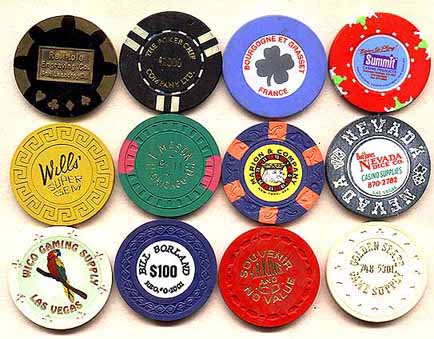
Most casinos and clubs wanted their names on their gambling chips for two reasons: it gave a cachet to the place, and a distinctive name or logo helped deter counterfeiting or "ringing in" outside chips. The inscription went in the center of the chip, applied one of two ways. It was either hot-stamped by the gambling-supply distributor — who applied gold or silver foil himself using a hot-stamp machine die on his chip inventory (for example, the "Wills Super Gem" inscription on the yellow chip above) — or inlaid by the distributor's manufacturer while the chip slug was being molded (for example, the round, colored, printed, coated litho inlay on the Marion & Company chip above).
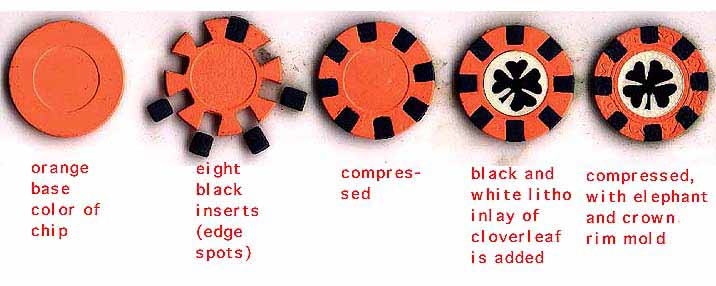
Colored inserts (edge spots) could also be ordered to further deter counterfeiting; these are added during manufacturing. The Marion chip has six peach inserts, and the green Mason & Co. chip beside it has two pink inserts. You can view the five stages of manufacturing an inlaid chip with inserts.
Embossed Rim Mold Design
A third and very interesting way to deter counterfeiting is a chip mold that leaves a unique embossed design around the rim. The eight chips in the bottom two rows above all have embossed, recessed rim designs. The idea was for each gambling-supply distributor to own one or more exclusive molds, letting him offer "protected" chips to his customers with a guarantee that no one else in the world could have the same chip.
Take the yellow Wills chip above as an example. It belonged to B. C. Wills and Co., which owned the "Large Greek Key" mold. If a customer with the initials "R. L. E." wanted an inexpensive set of protected poker chips, he would order from Wills, giving his initials and the type style they should appear in. Wills checked its alphabetical index-card records to see if anyone had already ordered those initials in that style. If not, the customer got his chips on the distinctive Large Greek Key mold, and Wills created an index card to ensure it never made the same initials and type style for anyone else. Another person could still order the same initials, type style and colors elsewhere — but never on the Large Greek Key rim mold.
The distributor was glad to use his exclusive rim mold: as prestigious clubs adopted it, the mold advertised him, serving as product promotion, brand identification and a symbol of quality. A byproduct is that today, when a collector finds a chip with a particular rim mold, it helps identify the distributor, the approximate age of the chip, and the region where it may have been used. Index-card records survive for some companies — Mason (hub mold), Jones Brothers (large squares), T. R. King Mfg. (crowns), Paulson (hat and cane), and others. A linked card won't answer every question, but it generally shows the quantity ordered, a date, and a name and address.
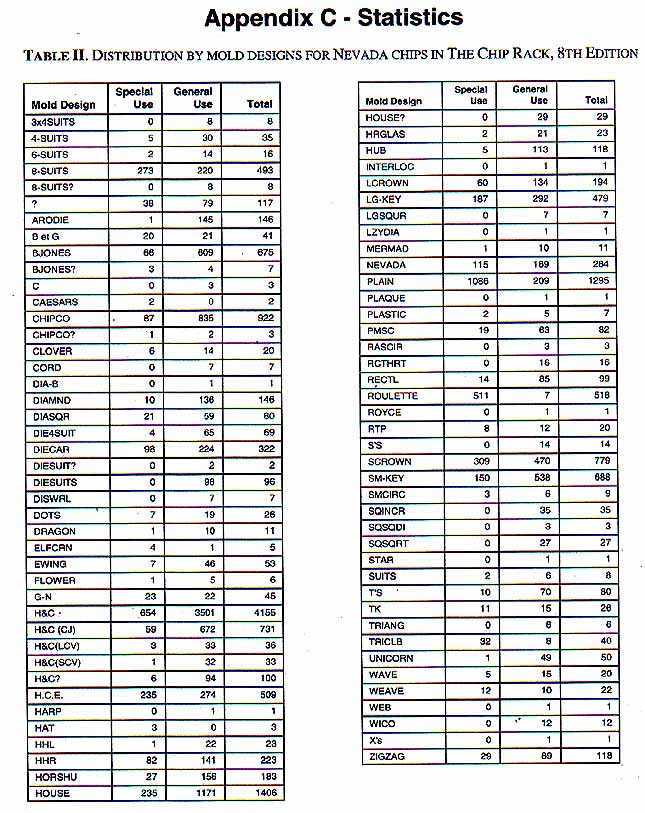
The prominence and location of a distributor help determine which molds were more likely to be used. Appendix C of The Chip Rack enumerates the number of Nevada chips for each rim mold design.
Scope of This Mold Project
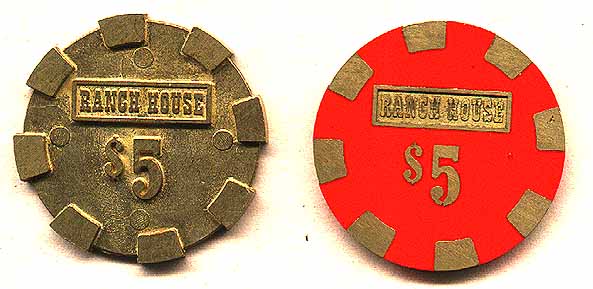
For this project I largely stick to molds that are old, clay and embossed. I do not include metal-plastic ones like the one in the upper left above, from Reliable Engraving Co., San Leandro CA. (Mel Jung specializes in these brass-core and bi-metal/plastic chips. Made from about 1971 to the late 1990s, they lost favor due to expense and a lack of the Chipco-like pictorial graphics required for limited-edition chips. Only two Nevada casinos still used them, both expected to discontinue in 2001.) For reference, here are pictures of metal-core chips and more, an aluminum core without the plastic, and a brass-core $5 Ranch House chip with and without the plastic.
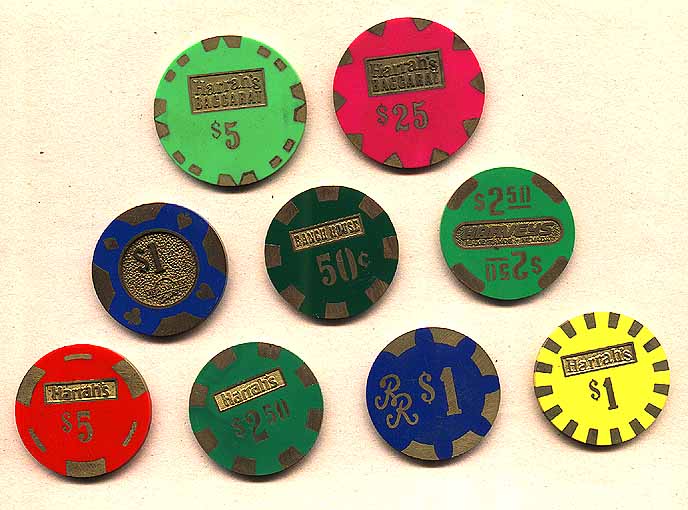
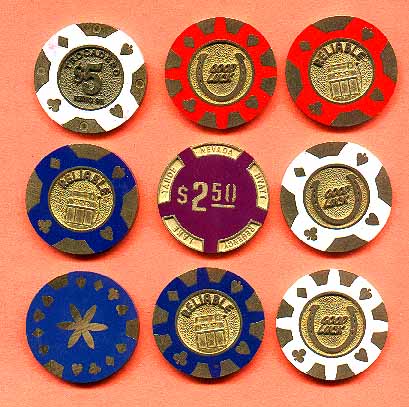
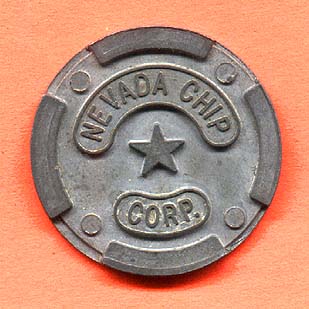
I also tend to stay away from the many recent plastic-nylon chips with inlaid (not embossed) design rims, like the three right-hand chips in the top row. (The blue chip in the top row really has no rim mold; it is a plain, flat mold chip.) The embossed mold designs were always recessed — they couldn't stand out in relief, or the relatively flat chips wouldn't stack properly. For scanning, I often pressed soap into the recessed design to highlight it, as with the Nevada mold chip above. I may have missed some molds, but I have at least included all the venerable ones.
Using Molds for Identification
It is almost impossible to date certain mold designs, given the lack of records and the questionable memories of old timers. Even if we knew exactly when a mold was produced, nothing stopped a club from using it for decades after the distributor abandoned it. An index-card record tells us only the name and address of the person who ordered or received the chips — which could have been used in the next state or across the country. Some molds became "open" (or were never "protected" to begin with) and were used by many distributors. Gene Trimble has reported that many U.S. molds are now being copied in Asia.
Sources of Information for This Project
In preparing this educational project I am grateful to Allan Myers for a list of the dates of many molds, Jim Blanchard for identifying many of the mold distributors, and Bill Borland's "Blue Book of Casino Chips," which sparked my interest in collecting all the old molds — it pictured and identified some 70 different molds. The Herz books (cited below) were also very helpful, particularly with the mold abbreviations widely used today. Further help came from the roughly 100 old gambling-supply catalogs I own and many distributor advertising chips, some pictured here. Personnel at many gambling-supply houses provided valuable information, as did the CC>CC's newsletter "Casino Chip and Token News," the Chipboard.com bulletin board, and conversations with many collectors, especially Gene Trimble.
Seeking Help: Chips and Information
I would appreciate any help with this project — both additional or corrected information, and chips for sale covering molds I have no example for. In the price column of the mold pages you'll sometimes see "None for sale… Find me some chips to list here." That means I need 10 to 100 chips to sell to the public for $1 or $2 above what I pay. I'll acknowledge any help I receive.
References and Links for Mold Information (in no particular order)
- World-Wide Casino Exchange (Bill Borland), "The Official Blue Book of Casino Chips and Gaming Tokens" (Las Vegas NV; no date, but about 1988; out of print).
- Howard Herz, "Harvey's Guide to Collecting Gaming Checks and Chips" (High Sierra Numismatics, Minden NV; 1985 — probably out of print).
- Howard W. Herz and Kregg L. Herz, "A Collector's Guide to Nevada Gaming Checks & Chips" (Whitman Coin Products, Western Publishing Co., Racine WI; 1995).
- Chequer's Magazine (online), particularly Gene Trimble on chips, and its bulletin board.
- Casino Chips and Gaming Tokens Collectors Club home page. The club publishes an informative quarterly magazine ("Casino Chip and Token News"); see also the club's reference page.
- "The Chip Rack: A Price Guide to the Casino Chips and Checks of Nevada," by Allan Myers, Michael Knapp and Ernest Wheelden (KMW Publishing Co., PO Box 17002, Louisville KY 40217). An updated edition is published yearly; available from the publisher or any chip-supply outfit. The same authors' "The Gaming Table" is extremely helpful for identifying old chips: it lists chip inscriptions (e.g. a monogram like "JF" or a name like "Imperial") alphabetically, with the mold design, club name, opening and closing dates, and known attribution. It also has a small section picturing characters (including Chinese) that appear on chips with no English letters, and tries to identify them.
- The Chipboard.com bulletin board.
- Michael Knapp and Dick Covington, "Chipology 101 Seminar", part of the CC>CC website — an excellent 45-page online course covering inlays, inserts, molds, foreign chips, tokens and more.
- Pete Rizzo's Las Vegas Casino Chips & Collectibles also has a list of old-mold pictures; at the site, click the map next to "Casino Chip Molds."
- Casino vendors directory.
- Rich Hanover's "Plain Mold, Litho Inlaid Poker Chips."
- Published
- Apr 13, 2024
- Page views
- 916