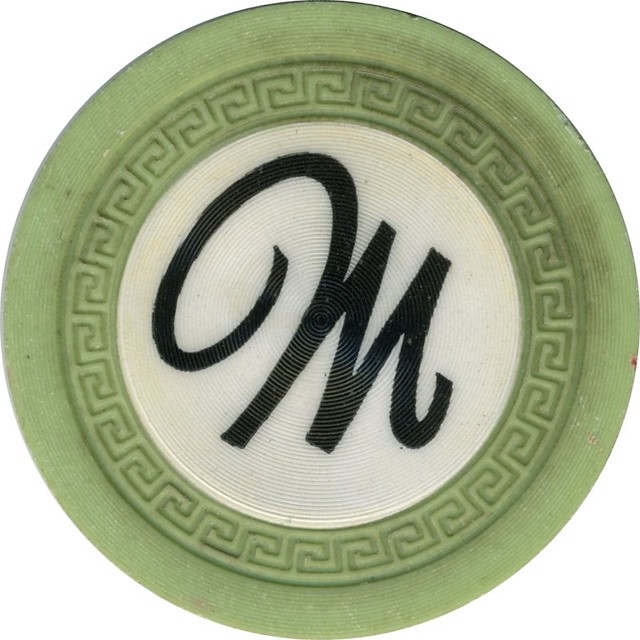
Sawtooth $1.00 (2 Viewers)

HRHGuy

Sitting Out
Joined
Oct 7, 2025
Messages
20
Reaction score
16
Rewards
77
Location
Angel Fire, NM
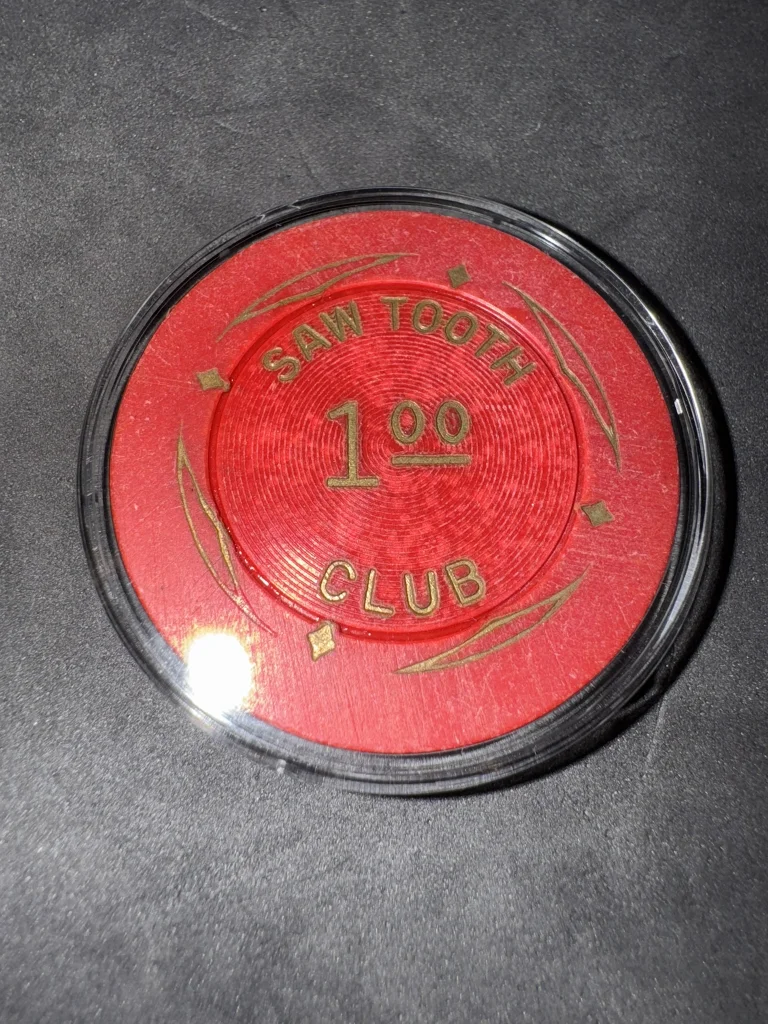
I recently purchased this chip with a group of other vintage chips. I don't know much about this establishment if anyone know years of operation it would be appreciated.
A poker buddy that suggested this forum thought it was cool, so thought I would share.

IMG_1724.webp

Per chipguide.com:
Sawtooth Club
Ketchum, Idaho
Type: Illegal
Status: Closed
Close: Yes

Justin
 
The place was a very active gambling joint from the 1930s to at least the 1950s. Using newspapers.com, I can see that it was raided several times during that time period, with equipment seized each time. Below is a For Sale ad from April 1945. The owner was definitely not trying to disguise what was going on there.

Saw.webp


Your chip is more likely a poker chip than a roulette wheel chip. From what I read, they had black jack too.

The place is still open, with gambling long gone.
Saw2.webp
 
@Jeff in Iowa nails it! Regrading the chip's origins... I hadn't seen that particular hotstamp pattern before. Here's a couple examples I've got on hand. You'll notice the "ring" around the machined circles is either thick or thin - you've got a thin one just like the red THK chip shown here. I don't know if these originated from the same factory or not. According to Eisenstadt's list it appears these came from different places but I'd love to see a more definitive source (e.g. catalog from the suppliers showing what exactly they offered). See MD-94-96 here:
http://www.antiquegamblingchips.com/molddesign_other.htm

machined Large.webp
 
@Jeff in Iowa nails it! Regrading the chip's origins... I hadn't seen that particular hotstamp pattern before. Here's a couple examples I've got on hand. You'll notice the "ring" around the machined circles is either thick or thin - you've got a thin one just like the red THK chip shown here. I don't know if these originated from the same factory or not. According to Eisenstadt's list it appears these came from different places but I'd love to see a more definitive source (e.g. catalog from the suppliers showing what exactly they offered). See MD-94-96 here:
http://www.antiquegamblingchips.com/molddesign_other.htm

View attachment 1577948
What chips are these? Compressed clay or plastic?
 
What chips are these? Compressed clay or plastic?
I haven’t done a deep dive, nor found any definitive sources

But I believe they’re more like compressed clay than like plastic, but uhh… this is not well supported.

Some were made by Hunt in Illinois who made the various chain mold chips, of which some were compression clay and others definitely more on the plastic side. They also made checkers and backgammon tokens that were more plastic.

I forget the company that made the machined chips based in Louisiana … similar to these pictured here, but that might offer some evidence if dug up
 
I haven’t done a deep dive, nor found any definitive sources

But I believe they’re more like compressed clay than like plastic, but uhh… this is not well supported.

Some were made by Hunt in Illinois who made the various chain mold chips, of which some were compression clay and others definitely more on the plastic side. They also made checkers and backgammon tokens that were more plastic.

I forget the company that made the machined chips based in Louisiana … similar to these pictured here, but that might offer some evidence if dug up
Eisenstadt did a lot of great research, but his claim that the Hunt Co. made these chips is wrong. Hunt never made or sold either version of them. I think he is confusing it with a different circular design chip that Hunt did sell.

The Burt Company made both versions of the above Circles Mold chips between the late 1940s and the mid (possibly late)1950s. I don't think anyone else made them. They are compression clay chips, although the composite formula is slightly more plastic than Burt's later chips.

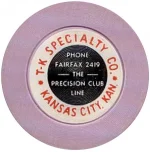
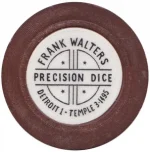
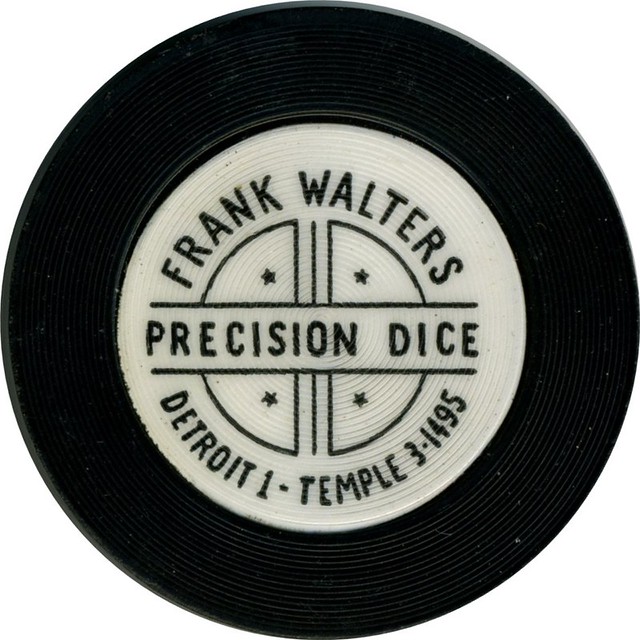
Unlike most chip molds, the mold was an open mold. Any distributor could use it, and several did. Below are gambling supply distributor advertising chips from T. K. Specialty and Frank Walters. Both were active in the late 1940s and early 1950s. Frank Walters closed shop in 1956. (You may need to click on the thumbnail pics to see the circle grooves.)
specialty.webpWalters.webp

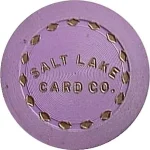
I believe that the Sawtooth Club chip, and Gus's FSL and THK chips were all hot stamped by the Salt Lake Card Co. (Salt Lake, Utah) a gambling supply company founded and owned by Edward A. Stroud from 1949, until his sudden death in 1958. Stroud used both versions of Circles mold, and below is one of his advertising chips. Note that the advertising chip has the same diamond hot stamp pattern in the large circle gap as Gus' FSL chip.
salt.webp

Most serious gambling supply companies of that era had their own proprietary edge mold design to protect their customers from counterfeit "ringed in" chips. If they used an open mold, and hot-stamped it, it was still possible for a patient counterfeiter to order the chips from another distributor, and have the hot stamp duplicated. Instead of getting an expensive custom edge mold chip design, I think that Stroud tried to get around that problem by creating a hot stamp that would be hard for anyone to duplicate. Its hard to precisely center a hot stamp on a chip, but he somehow managed to get it inside that tiny groove every time.

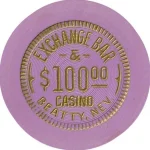
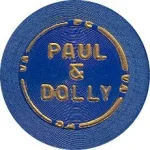
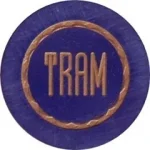
Below are some more chips that I believe Stroud hot-stamped. It may be hard to see on the thumbnail pics, but all are on the Circles mold. I've never seen this style of hot stamp on anything other than the two versions of the Circles mold.
exchange.webpPaul.webptram.webp

It's possible that other distributors used Stroud's style of hot stamping, but I have not seen evidence of it. Also, in relation to the Sawtooth Club chip, Ketchum is in southern Idaho, and Idaho borders Utah to the north. Salt Lake City is just a four-hour drive away.

 
Last edited:
@Jeff in Iowa that's great info!

Do you know if the circles are in fact machined, or is this coming from the mold itself? Presumably you'd have to run them on a lathe or something to machine the circles in? Now that I think about it that sounds outlandish to do for every chip.

I thought there was a company out of Louisiana that made the inlaid circles chips but I can't find any of the details in my notes... I vaguely remember them maybe being made in the 90's. The "ridge" is a bit different around the inlay compared to the pattern seen on the hotstamped chips which suggests a different mold was used.

It does look very close to the TK Specialty sample chip you posted... maybe that's it after all.

Odwyers.webp
 
My understanding is that the radial grooves had to be in the master dies and the mold cups. They weren't added afterwards. There had to be at least two sets of molds, one for each version of the circles mold. There are also some early Diamond mold chips that have similar radial grooves, and I think that those were also from a different set of diamond mold cups. It's possible that some of the original mold cups might be held at the American Gaming Archives in Reno.

Howard Herz in his 1985 guide to collecting old gaming chips reproduced a bunch of old distributor catalog pages. One of them is a page from a late 1940s/early 1950s O'Neil catalog. The black and white reproduction is not great, so I put my chips next to it, but you can see that they were selling generic inlaid circles mold chips.

Oneil.webp
 
Last edited:
Eisenstadt did a lot of great research, but his claim that the Hunt Co. made these chips is wrong. Hunt never made or sold either version of them. I think he is confusing it with a different circular design chip that Hunt did sell.

The Burt Company made both versions of the above Circles Mold chips between the late 1940s and the mid (possibly late)1950s. I don't think anyone else made them. They are compression clay chips, although the composite formula is slightly more plastic than Burt's later chips.

Unlike most chip molds, the mold was an open mold. Any distributor could use it, and several did. Below are gambling supply distributor advertising chips from T. K. Specialty and Frank Walters. Both were active in the late 1940s and early 1950s. Frank Walters closed shop in 1956. (You may need to click on the thumbnail pics to see the circle grooves.)
View attachment 1578076View attachment 1578078

I believe that the Sawtooth Club chip, and Gus's FSL and THK chips were all hot stamped by the Salt Lake Card Co. (Salt Lake, Utah) a gambling supply company founded and owned by Edward A. Stroud from 1949, until his sudden death in 1958. Stroud used both versions of Circles mold, and below is one of his advertising chips. Note that the advertising chip has the same diamond hot stamp pattern in the large circle gap as Gus' FSL chip.
View attachment 1578085

Most serious gambling supply companies of that era had their own proprietary edge mold design to protect their customers from counterfeit "ringed in" chips. If they used an open mold, and hot-stamped it, it was still possible for a patient counterfeiter to order the chips from another distributor, and have the hot stamp duplicated. Instead of getting an expensive custom edge mold chip design, I think that Stroud tried to get around that problem by creating a hot stamp that would be hard for anyone to duplicate. Its hard to precisely center a hot stamp on a chip, but he somehow managed to get it inside that tiny groove every time.

Below are some more chips that I believe Stroud hot-stamped. It may be hard to see on the thumbnail pics, but all are on the Circles mold. I've never seen this style of hot stamp on anything other than the two versions of the Circles mold.
View attachment 1578090View attachment 1578092View attachment 1578093

It's possible that other distributors used Stroud's style of hot stamping, but I have not seen evidence of it. Also, in relation to the Sawtooth Club chip, Ketchum is in southern Idaho, and Idaho borders Utah to the north. Salt Lake City is just a four-hour drive away.

Thanks for the info @Jeff in Iowa

I do have a Frank Waters chip.

51329796694_b2ab3729be_z.jpg


I need both the Salt Lake and TK Specialty chips lol. I have an O'neil catalog but i only recall the cord mold chips being in there. I will double check later.

I also have a small key with an inlay with the same circles:

53597129524_e8ba8d3222_z.jpg


Not sure if the groves wear down or if they are different molds, but the chips that I posted have the circles impressed in the outer rim as well.
 
Could the circles have been a sort of final finishing mold unrelated to the Greek key or diamonds? (I’ve got one of the diamonds version)

It’d just be one more step in the process, another round of compression molding.

Never seen the Greek key with the circles!
 
Could the circles have been a sort of final finishing mold unrelated to the Greek key or diamonds? (I’ve got one of the diamonds version)

It’d just be one more step in the process, another round of compression molding.

Never seen the Greek key with the circles!
I suppose something like that is possible. However, it would take twice as long to make the chip.

Another possibility is that some Small Key and Diamond mold cups were machined with those radial grooves after being cast from the master dies (hobs). From what I understand, the master dies/hobs, made from a very hard steel, were the expensive components to produce. I recall hearing that they cost around $15,000 to design and make, though I can't remember from what era that figure refers to. Each of those hobs could make many (at least dozens of) mold cups, which were far less expensive to manufacture.

You would have to ask a machinist, but it may not have been too difficult to cut those grooves into some existing Small Key and Diamond mold cups. For whatever reason, the experiment was not a full success, as those grooved versions were only briefly made.

Below is an example of a Diamond mold chip with those grooves (courtesy of the ChipGuide).
diamond.webp
 
Last edited:
  • Like
Reactions: Gus

Create an account or login to comment

You must be a member in order to leave a comment

Create account

Create an account and join our community. It's easy!

Log in

Already have an account? Log in here.

Back
Top Bottom