
Triple Action Poker – Three Boards, One Deal (1 Viewer)

DerberAlter

Flush
Joined
Nov 5, 2018
Messages
2,297
Reaction score
3,166
Rewards
0
Location
Munich, Germany
Hi everyone,

I wanted to share a poker format I’ve been tinkering with for a few years called Triple Action Poker (TAP).

It originally started as something we’d play before or after a regular game when we still wanted a few quick hands. Over time it stuck, and now in my group it occasionally replaces the main game entirely.

It’s a 2–5 player variant, plays fast, and works surprisingly well heads-up.

If anyone’s curious, I built a small web version here where you can try it: https://triple-action-poker.com
You can play against bots or other players. Works fine on a phone too.


The basic idea

Every hand runs across three boards at the same time, and each player must decide which of their hands belongs where.
  • Each player gets 7 cards and builds 3 pocket hands (2 cards each, one card discarded).
  • The dealer puts out three community boards (starting with 2 / 3 / 4 cards).
  • Players then assign one pocket hand to each board (face down).
  • There’s a short betting step where players can double on certain boards (and with 3+ players also fold one).
  • Boards run out to 5 cards and then showdown happens board by board.
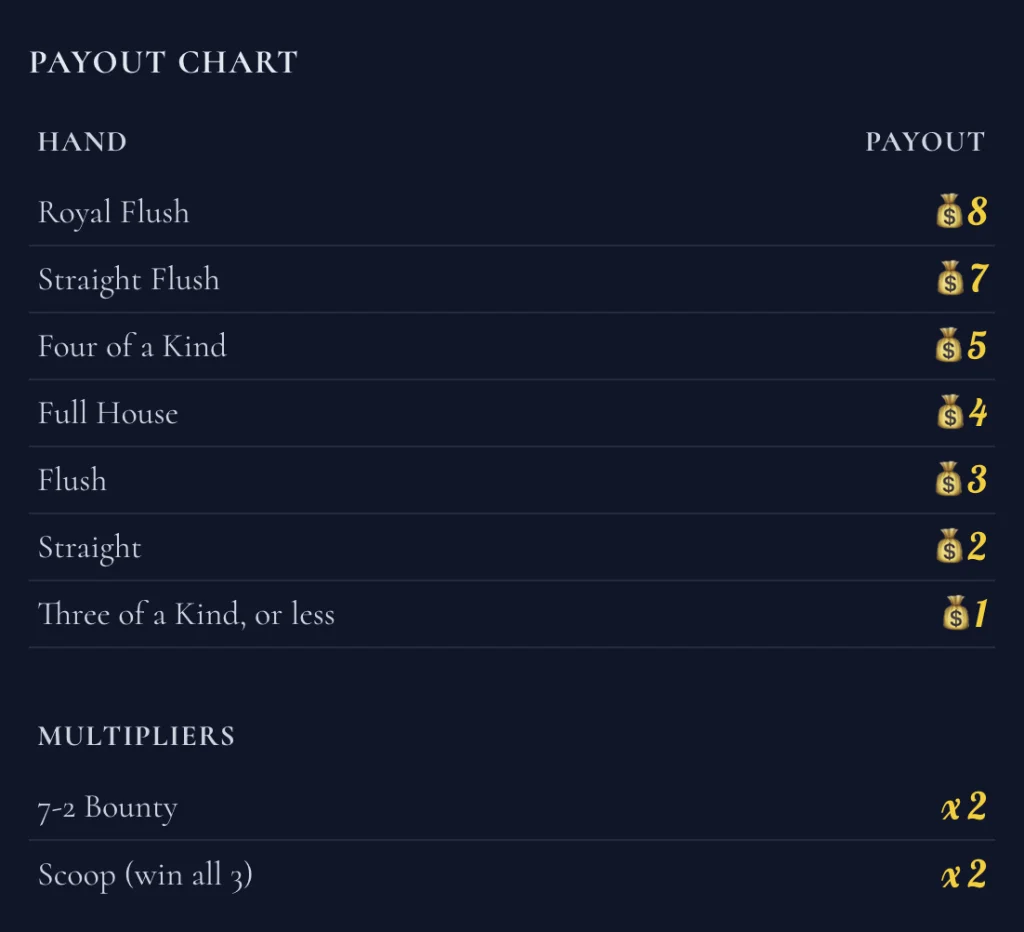
Payouts depend on hand strength and multipliers — see chart below:

Bildschirmfoto 2026-03-07 um 20.43.45.webp


Because you’re matching three hands to three boards every deal, there’s always something interesting happening.


Scoop & Mystery Board

One mechanic that adds a fun twist: Scoop: If someone wins all three boards, all their payouts for that hand are doubled.
And the next hand the middle board is dealt face down — the Mystery Board — and only revealed at showdown. So players have to assign their hands without knowing what that board will look like. It creates some great moments at the table, and adds more randomness to this hand.


Why it stuck in our games
  • Quick to learn
  • Very action-heavy per deal
  • Great heads-up
  • Plays fast live
It also feels a bit more swingy than regular poker. The edge is smaller, but there’s still plenty of room for good decisions when assigning hands or choosing when to double or fold


Interested to hear what people think.
 
Last edited:
Quick follow-up in case my original post just got lost in the noise.

I put together a small browser version so you can actually try Triple Action Poker instead of just reading about it: https://triple-action-poker.com/

No signup needed. Right now, there are many tables running. If anyone here is curious enough to give it a spin, I’d love to hear what you think.
 
It looks like a fun game, my question is how it actually plays in a live game. How do you track who has doubled and folded on each board? And are the payouts on each board split evenly between the 2 losers? So if i get a fullhouse on board one against 2 opponents and no one folded, they each pay me $4? whereas if one had folded i would only get $4 from one of them? And if neither folded and i doubled i would get $8 from each? And if all three of us doubled i would get $32 from each?
 
Just tried it ... fun way to waste some time at work! Bookmarked!
Although to play this live would break my brain.
 
It looks like a fun game, my question is how it actually plays in a live game. How do you track who has doubled and folded on each board? And are the payouts on each board split evenly between the 2 losers? So if i get a fullhouse on board one against 2 opponents and no one folded, they each pay me $4? whereas if one had folded i would only get $4 from one of them? And if neither folded and i doubled i would get $8 from each? And if all three of us doubled i would get $32 from each?

Thanks, and yes, it definitely sounds more complicated on paper than it feels once you actually deal a few hands live.

We usually just define a base unit at the start, for example 1 point = $1.

For tracking:
  • if you fold a board, you put a $1 chip on the hand you assigned to that board
  • if you double, you place your dedicated double chip on that board’s community cards
That makes it very easy to see both who folded and how many times a board was doubled.

As for payouts, the losers do not split the amount between them. Each losing player pays the full board value.

So in your full house example, if that board is worth $4:
  • if 2 opponents are still live, each pays you $4
  • if one of them had folded, only the remaining live player pays you $4, the player who foldet just pays you $1
  • if you doubled - and nobody foldet - then each live loser pays $8
  • if all 3 players doubled that board, then each live loser pays $32
What also helps live is that once a board is complete, the losing hands are turned face up and each losing player places the amount they owe directly on their own exposed cards.

And for the scoop rule, it’s also pretty visible: if one player wins all 3 boards and no other hands are left live, that player scooped. In that case, you just double the amounts already sitting on the exposed losing hands.

Honestly, I think it clicks pretty fast once you’ve tried a few hands online. After that, the live version feels much more intuitive than it probably reads in a text explanation.
 
I did play a few hands online, but admittedly i was pretty distracted and wasn't carefully tracking the payouts. I think my players would rebel at having to track 3 different hands going to 3 different boards, on top of having to keep track of different payouts for making different hands (and wouldn't love how much they have to payout being dependent on how good a hand someone else made). I have a hard enough time getting them to play SOHE.
 
I did play a few hands online, but admittedly i was pretty distracted and wasn't carefully tracking the payouts. I think my players would rebel at having to track 3 different hands going to 3 different boards, on top of having to keep track of different payouts for making different hands (and wouldn't love how much they have to payout being dependent on how good a hand someone else made). I have a hard enough time getting them to play SOHE.

Yeah, that is completely fair.

I honestly would not try to introduce it live as a full-game replacement for a table that already prefers standard formats. I think it works best live as a heads-up game to start with.

The ideal spot for it, at least in my experience, is when the main game has broken and 2-3 people still want to keep playing. Then it is short-handed, people are more willing to try something different, and the flow becomes pretty intuitive after a few hands.

So if your group already pushes back on SOHE, I can definitely see this being a hard sell. But as a heads-up or short-handed after-hours game, it has worked surprisingly well for us.
 
Been loving this game lately as it’s usually just the four of us…it’s hard finding people to play poker where I’m at even if I am hosting. My sons and I have changed the rules a little bit from what’s listed above. Dealers choice on how the cards are dealt for each board (ie. how many are face up vs face down) so there’s an element of gamesmanship to it before the first round of betting and before the second round of betting. I am putting in the multipliers listed above for our next game night

This is a limit game for us using $1 chips and it can get costly quickly🤣. Probably gonna change that to either quarters or fifty centers in the next couple of games.

Was thinking It would be to cool to have a dedicated smaller mat for this game. Anyway, thanks for the invent on this game it’s loads of fun.
 

Create an account or login to comment

You must be a member in order to leave a comment

Create account

Create an account and join our community. It's easy!

Log in

Already have an account? Log in here.

Back
Top Bottom