Cash Game Starting Stacks for 10-handed .25/.50 Cash Game (1 Viewer)

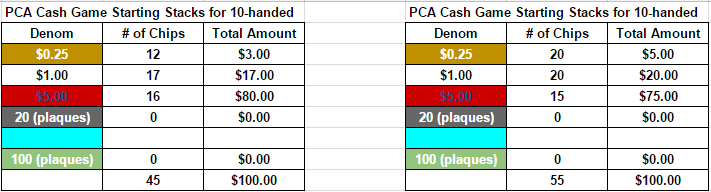
So basically I'm torn between these 2 options:
30f34df0c4a6ee9dc623f10c099ddba1.png

I'm not torn - I go for the 20/20, in a heartbeat. Why?

Even if I'm expecting 10 players, I may only get 8.

And even if I get 10, we'll put cards in the air after the first four or five show up.

So I buy people in with clean stacks of 20 while I got 'em.

If, by some weirdness, I had 160 quarters and 10 players all showed up ready to play... I'd buy in six people with full stacks, and then four people with 12 or 8 each. Just quicker and easier.

NOTE: part of why this makes it quicker and easier for me is because I absolutely insist that someone at the table verifies a buy-in before it goes out. I never go just by how I cut them out, nor simply "trust myself." It's old dealer habits... it's better to have someone check you. I've definitely had people catch my mistakes... but as a result, my cash box is always almost right at the end of the night. (I was away from my regular game in NYC for awhile, and when I came back, they told me the box wasn't right a single time while I was gone.)

TL;DR: buying in with clean stacks also makes it easier for the players to verify that they're getting the right number of chips, which means fewer errors.
 
Last edited:
So basically I'm torn between these 2 options:

30f34df0c4a6ee9dc623f10c099ddba1.png
Moaar chipes FTW. Game will run faster (less change-making), and more chips in play promotes looser play (players are less likely to hoard larger denominations). Selling even barrels also means fewer banking errors. Win-Win-Win.

Personally, I'd bump the buy-in $125 and just give everybody three barrels (one of each denom).
 
Chips constantly move around the table. You absolutely do not need more than 120 quarters if this game plays big. Starting stacks of 12/17/12/1 should work fine. I can't imagine that 170 $1's would not cover the bets at the table based upon your description of the game.

How many re-buys do you have in a typical night?

IMO, You might as well get those $20 plaques on the table at the outset if you are going to have more than $1500 on the table. I would give a barrel of $5 to those players re-buying into the game.
 
That's true regardless which opening breakdown you choose. A bigger starting stack can slightly delay when the change-making starts, but not by long, and after you get there, you tend to stay roughly at that same level of change-making for the rest of the night, regardless what the starting stacks were.


Exactly. With regulars at the table, they quickly learn to prefer making one-chip calls and waiting on change from the pot, rather than trying to make change with each other. Pretty much only newbs try to make change with each other... or someone trying to help someone who has too damn many small chips to manage.

Some players prefer to make one-chip calls four or five times rather than to buy change... every time the do a one-chip call, they get enough change for next hand... eventually, they win a pot, and get a bunch of fracs from it. The pot change doesn't slow down the game in the slightest, among regs.

It sounds like how it is at the casino which does play slower. The $1/3 game has almost no $1's on the table because they are constantly being dropped by the dealer so players put out a $5 chip to limp and the dealer has to make change for 6 players before dealing the flop.

When there are enough for chips for each player to have 20 $1's and 20 $5's per player when a player needs to make change from the big stack they buy 20chips so they are good for a while, not 5 so they have do it again next hand.

I would imagine there could be some arguements coming up with the oversized chip rule and if it is a call or raise later in the night when people are tired and or a little drunk if someone said "raise" or not.
 
Chips constantly move around the table. You absolutely do not need more than 120 quarters if this game plays big. Starting stacks of 12/17/12/1 should work fine. I can't imagine that 170 $1's would not cover the bets at the table based upon your description of the game.

How many re-buys do you have in a typical night?

IMO, You might as well get those $20 plaques on the table at the outset if you are going to have more than $1500 on the table. I would give a barrel of $5 to those players re-buying into the game.

There are lots of rebuys, including guys rebuying for $200. There will be over $2000 on the table within a couple hours
 
Similar game set up but I've decided to bump the quarters into 50c and run a 50c-50c game

Total Chips - amount - Starting Stacks
100 - 50c - 10
200 - $1 - 20
400 - $5 - 15
80 - $25
20 - $100

Total bank of $6,250. Can easily play 50c/$1 with $200 buying if you want to bump it up
 
It sounds like how it is at the casino which does play slower. The $1/3 game has almost no $1's on the table because they are constantly being dropped by the dealer so players put out a $5 chip to limp and the dealer has to make change for 6 players before dealing the flop.

Sounds like a weak game and a crappy dealer. Regardless, no rake at my house.

I would imagine there could be some arguements coming up with the oversized chip rule and if it is a call or raise later in the night when people are tired and or a little drunk if someone said "raise" or not.

Not a problem with regs... on a one-chip, whoever is dealing calls it out as a "call" when it's tossed. Never turns into a problem for us. But, in your example... the $5 chip is always a call. It's not a legal raise in 1/3.

There are lots of rebuys, including guys rebuying for $200. There will be over $2000 on the table within a couple hours

NOICE.
 
Sounds like a weak game and a crappy dealer. Regardless, no rake at my house.


Not a problem with regs... on a one-chip, whoever is dealing calls it out as a "call" when it's tossed. Never turns into a problem for us. But, in your example... the $5 chip is always a call. It's not a legal raise in 1/3.


NOICE.

I'm glad it works so well for your home game.

My point is though is that having more $1 and $5 chips on the table per player than 12 each makes for a better game overall for all the reasons that @BGinGA pointed out already. Also most home games in our area are self deal games that rotate around the entire table so constantly making change for every bet isn't as easily done.
 
Last edited:
And one vote here for the 20/20/15. :)

As host, I just hate counting out obscure chip stacks. And when I'm running 2 or more tables, being able to quickly grab full barrels just reduces my stress when trying to manage that many players.

I preset my starting stacks so this isn't a problem. Rebuys are either 20 x 5 or 4 x 25.
 
There are lots of rebuys, including guys rebuying for $200. There will be over $2000 on the table within a couple hours

I would use barrels of $5's and twenty dollar plaques for re-buys.

Poker is a game of odds. Only inexperienced players would ever get caught playing looser because they have a 100 quarters in front of them versus 25 $1's.
 
I would use barrels of $5's and twenty dollar plaques for re-buys.

Poker is a game of odds. Only inexperienced players would ever get caught playing looser because they have a 100 quarters in front of them versus 25 $1's.

Poker is a game of many things, odds is just part of it. There is a lot of phycology in poker. Chips themselves are part of it. Casinos use chips because they aren't "money". People are more gambley with more chips than fewer. If you aren't, good for you, but it is true none the less.
 
Poker is a game of many things, odds is just part of it. There is a lot of phycology in poker. Chips themselves are part of it. Casinos use chips because they aren't "money". People are more gambley with more chips than fewer. If you aren't, good for you, but it is true none the less.

Can you point me to a source to verify the veracity of your claim? Or are all of your opinions facts?
 
+1 for capping the quarters at one rack.

As a guy who used to love having tons of quarters in play, trust me... you really do not need more than 100 quarters on the table. It may give you a fun mental image of having tons of chips on the table, but it ultimately becomes a pain in the ass... especially if people are trying to make bigger bets with .50/1.00 type of play taking place. Shoving barrels of quarters to make a 10 dollar bet is just silly.

10 buy ins are pre set. If only 8 show then I use the two pre set stacks as re buys first. Then I have three rebuys cut out and ready to go before moving onto the greens. If someone wants to add on 20 bucks or something I have a rack put up for that :) easy peasy

20170318_094918_zpstbc6wcq5.jpg
 
four or five? We start playing as soon as the first player gets there lol.

Depends who shows up first. Some of us actually like to hang out, too.

Also most home games in our area are self deal games that rotate around the entire table so constantly making change for every bet isn't as easily done.

All my games are self-dealt, too. Doesn't seem to make a difference.

Also, change isn't constant. Usually, it's raised pre-flop and the change becomes irrelevant. If not, then players usually have change, anyway. If not, the other bets usually have change and it's resolved while pulling the money in with no time lost.

I have three groups of regs, and the change is never an issue. Maybe it's because of the example I set as an ex-pro dealer, but I don't think so. I think mostly it just feels right when you start doing it, so it sticks.

The biggest problems my players have, when dealing, are:

1. Being too eager to deal turn or river and forgetting to pull in the money, first.
2. Forgetting they're dealer and that they still have to deal the turn and river!

:ROFL: :ROFLMAO:
 
In my regular cash games it always seems like the quarters gravitate towards one or two players and then everyone forgets they are there and just uses larger denom chips. Or players make change from the pot if they need to.

Also try to use fewer chips as MOAR! leads to players building weird castles and fortresses out of their chips if they win a big pot or double up through another player.
 
Can you point me to a source to verify the veracity of your claim? Or are all of your opinions facts?

Here is a good article that supports what I am saying that more little chips makes people spend more than having just a few big chips (bills).

http://content.time.com/time/business/article/0,8599,1887485,00.html

It is not a new concept that I just came up with. There are studies cited within the article as well that show people spend more when they have many small bills.
 
Last edited:
Looking for some advice here: pretty much everyone will buyin for $100.
The game plays more like .50/1.00 (lots of straddling) but the host does NOT want to raise the stakes.

How's this look?

JE6XhNyigM71BdqFTezTivhkVf95Yhi2WESNdNoyyigZz5IQkGduUXw6lgZA9V5Hz2xAORoq2r_KT72OhEozOzzDM58sCtnoWoEWld6VQSJtSpc7vyS_dNYHvVvEABGB4yFPQKogfWsx3ZMBEaP8GFiUsY9hy9OFMoGBWKyrBMUSSC8nUe7TPc3_61oiuAi6uVgmA8WLHrIRWfFeFVUa71e2-Jpe3gtNKB6r5jZFZUp9nZ3chIl3diH97Ul6SdoWAKwhzxzX7LpdLdEwSFZa3OAHNRZLgwM9y-JV3dzHaWoW8iExAIZxu93dCO2X5Ry5SH3muyizMGuTHV8T5txPWQz6dRmBXWIHWhYmwyUz-U8wiGeiO-W6s2f-t5zAqIGvsIMRqnid1sMT-APbQBsUrXkCrOv8eokiCyA9ib3TBfzf4Jv1aiE_de2WfO5LI-TDVhZJXzsRv2ijFTElWa1Et50M8uHsT3LzHDf8kAdGA-VcFWZZTMZrUf2rEhcy-0DjJ1MGZgMf8Rshs7qrE088LfxeKrOJpFyKHRwlZ1TLujQDftfTQOYfqQNZehjRxwmPUwudaQ2hi0YahKIJan4MIAOtx9kjhjs_TqQmlKR4CJ5Jpq8GjUPrfQ=w710-h194-no

I like $5 in quarters just to keep the game moving without a lot of pot change.
Then either $20 in ones and $75 in fives, or, $40 in ones and $55 in fives.
........ Depends on how your group plays
 
Here is a good article that supports what I am saying that more little chips makes people spend more than having just a few big chips (bills).

http://content.time.com/time/business/article/0,8599,1887485,00.html

It is not a new concept that I just came up with. There are studies cited within the article as well that show people spend more when they have many small bills.

Not going to get involved in debate here, but will chime in with my two cents:

The psychological effect of chips @Rhodeman77 is talking about is real, but I don't think it's a primary reason for the use of chips. Primary driver is practicality.

That being said, many people are looser when they have more chips than when they have fewer, given the same dollar value in chips... But I feel the effect is strongest with the smaller workhorse than with the blinds chip. In a 25c or 50c game, people with a lot of singles loosen up the most, calling them off against PF raises.
 
I wasn't saying the only reason casinos use chips is because of the psychological effect. They obviously serve many practical purposes for casino as well.

But casinos do know that people will spend chips more readily than they will actual US currency.
 
I love to see all the different ideas, They ALL have valid points....

I would try both with your group and get feed back, thy the 12/17/16 first, if you run into issues you can trad out chips.. Then you know how your group deals with it and you can make a CHANGE on the next game......
@tentoesdown

@Rhodeman77 As @Shaggy said, I have two dedicated dealers that RUN the game on their deal....These break downs work really well and we really dont do a lot of CHIP exchange.. I am going to, However, get more 1's and 5's and no 20's this Friday, then rebuys will be 20's... (just to see how it goes)..
 
Here is a good article that supports what I am saying that more little chips makes people spend more than having just a few big chips (bills).

http://content.time.com/time/business/article/0,8599,1887485,00.html

It is not a new concept that I just came up with. There are studies cited within the article as well that show people spend more when they have many small bills.

Read the article you cited. The gist of it is contained in these two paragraphs:

"People tend to overvalue bigger bills," says Joydeep Srivastava, a marketing professor at the University of Maryland's Robert H. Smith School of Business and a co-author of the study. "There's a psychological cost associated with spending a $100 bill that's not there with spending smaller bills." We tend to isolate the cash in our minds. Each $20 is a separate, less valuable entity than that single $100 bill. So it's easier to part with five of those twenties than with a single precious hundred in our pockets.

Further, consumers fear that once they break that large bill, they won't be able to stop spending the rest. "Once that barrier is passed, it's like a dam gets broken," says Srivastava. "And we've found that when people decide to spend, they'll spend more with the bigger bill than with the smaller bill." Researchers have labeled this phenomenon the "what the hell" effect: "I've broken the hundred; it's gone from my wallet. What the hell, I may as well blow off the rest." So consumers, afraid that the "what the hell" effect will drain their wallets, hold on to those large denominations.

Buying consumer goods is not equivalent to placing a bet. The article states a $20 bill has less buying power, so therefore is less valuable. I agree. However, I am neither more nor less likely to place a $100 bet when I have twenty fives in my pocket versus a single $100 bill.

The "what the hell effect" applies to poker players who are short stacked, because their remaining chips become less valuable to them,
 

Create an account or login to comment

You must be a member in order to leave a comment

Create account

Create an account and join our community. It's easy!

Log in

Already have an account? Log in here.

Back
Top Bottom