

Keep thinking about this given peoples experience w/ flattening chips (creating donuts, double molds), etc... feels like there's an opportunity to "re-mold" chips - i.e. put in a worn THC chip into a tool and regain sharp edges/texture/etc (with materials coming from the center/recess area of the chip).
Assuming this won't go anywhere, but wanted to at least put on paper so I can be told this is a fools errand or incase someone out there has the means/desire to try this. lol
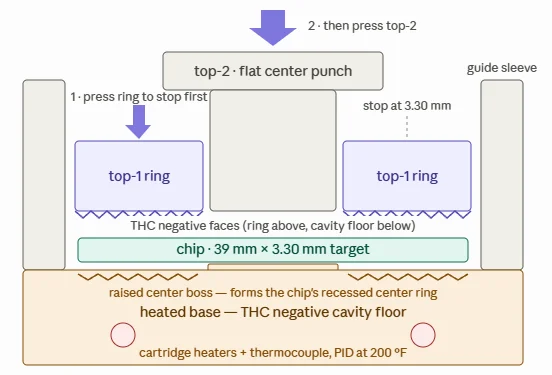
Concept
A three-piece die set consisting of:
Cycle
Soak the chip in the closed cavity 3–5 min at ~180–200°F → seat the ring (~500 lbf) → drive the center punch to the hard stop, hold 2 min, and cool the whole clamped stack before release.
Biggest issues I see are:
Assuming this won't go anywhere, but wanted to at least put on paper so I can be told this is a fools errand or incase someone out there has the means/desire to try this. lol
Concept
A three-piece die set consisting of:
- Heated base — aluminum or steel block with a 39.3mm chip pocket. The pocket floor carries the negative of the mold pattern for the bottom face.
- Top-1: floating ring — slides in a guide sleeve, carries the pattern negative and rim profile for the top face outer band. This seats first.
- Top-2: flat center punch — slides inside the ring, could also be textured.
Cycle
Soak the chip in the closed cavity 3–5 min at ~180–200°F → seat the ring (~500 lbf) → drive the center punch to the hard stop, hold 2 min, and cool the whole clamped stack before release.
Biggest issues I see are:
- Slow.. could theoretically expand the setup to do multiple chips at a time, but hard given how these would be pressed, as well as cooling time to make sure they don't re-warp.
- Flow... would just have to test and see to determine if the amount of heat and pressure is OK
- Cost.. Probably could prototype a proof of concept relatively cheaply, but obviously would be relatively expensive ($1-$2k I'd assume) to get the 3D chip scans, CNC'd tools, etc.


