
-
PCF is an eBay Partner. If you make a purchase through one of our links, we may earn a commission at no extra cost to you. Thank you for your support!
You are using an out of date browser. It may not display this or other websites correctly.
You should upgrade or use an alternative browser.
You should upgrade or use an alternative browser.
Oiling chips (2 Viewers)
- Thread starter mummel
- Start date


Hobbyphilic
Two Pair
I feel this is entertaining, interesting and fun. My intended tone here is not argumentative.
I didn't think there would be any interest in the science of this topic. I genuinely thought people wanted big picture ideas.
I feel my key point has been overlooked. Even if all the science in the world suggests oiling chips increases value, desirability, longevity and whatever else, will other people actually do it? Would you recommend this practice? Would you do it?
Below I have included some science discussion, feel free to just skip it and move on with your life.
Exactly what claims are made about properly oiled chips? Appearance improvement, resisting contamination, ease of cleaning, prevent staining, decrease wear, preserving the chip...? I'm not trying to zero anyone out here, but if you want your chips to look like casino chips, would you not just take some black watercolor paint and weather them? In my experience most of them are just filthy.
Does applying mineral oil to a static (unused) poker chip help preserve it? To answer this we need a well thought out scientific study and set some limitations of this study. We would then conduct experiments, see what those data support and make a conclusion. The mobile nature of mineral oil suggests we would have to apply it regularly. If I were to conduct this study my hypothesis would be that mineral oil does not prolong the life of an unused poker chip. What do you think? What would cause a well made poker chip to degrade? Oxidation? Biological contamination leading to biological breakdown? Volatility of parent material?
What about an oiled chip for use? Will an oiled chip have a significantly longer usable life than an oil free chip?
If so, what are the economic costs of maintaining the set versus replacing the set? (time vs money)
I'll leave appearance and feel alone here, the science behind these seems as simple as creating statistical model of people's preferences.
I agree mineral oil offers a form of protection from staining but some science needs to be clarified. I think we are on the same page.
A hydrocarbon soluble solution will permeate a hydrocarbon solution. So a hydrocarbon soluble solution, such as Oil Red O, (I expect laughter now, as this is more likely to be found in a pathology lab than EVER at a poker table) will stain the oil on your chip and depending on the specific surface area and cation exchange capacity of your chip, you might have just ruined a chip. For those not familiar, mineral oil is a hydrocarbon solution. Remember those dyes, such as Oil Red O, will permeate mineral oil. So rather than warding off stains, mineral oil CAN be used as a highway for stains. Like I said, just clarifying the science. It depends on the chip.
So, being pedantic, mineral oil will likely protect your chip from water soluble contaminates that may stain your chip otherwise. Not so for ALL staining. (again laugh track goes here as this is a very scientifically true statement, just very pedantic) Unless you happen to have wax or fat staining products at the poker table, this is just ridiculous, but hey, it's science! There is also the chance, again study needed, that a water based stain may occur if mineral oil is displaced by a water based product.
Now let’s look at our newly formed hypothesis, “Applying mineral oil to a chip protects it from stains.” How would you create a study to support this? Should I make a video?
Clays used in plastic have a specific surface area. This is one of many reasons clay is used in plastic production. Any material that comes along with a higher specific surface area will actually cling to the oil more than your chip. When you wipe it off, the mineral oil goes with it. Any dust or dirt with a specific surface area less than the chip will cling, but not remove the oil (This based on the assumption there is not excessive oil on the chip). Without mineral oil, you could likely blow or dust that material off. What about contaminates that have a tendency to cling to high specific surface areas? Take bubble gum for example. If that surface area on the chip is flooded with oil, it is unlikely the gum would find the surface area it needs to stick.
Back to the hypothesis. Applying mineral oil to a chip prevents contamination. In other words, it keeps your chips clean. Okay, that is quite a study setup there, and any data might not apply to your specific situation. I also recall reading a chemical engineering article about use of bleached earth (clay) to remove contaminates from mineral oil. This suggests any contaminates in the mineral oil will more likely remain with your chip than with the oil when the chip is wiped down. Again, this is multifactorial.
The second hypothesis, Applying mineral oil to a chip eases cleaning. Wow, this also gets complex quickly. Are we talking time-and-motion studies? What is the threshold of easy? What is the threshold of clean? This is one subject that seems will end in a poll. Do you want to wipe down your chips or dust them off? Do you want to wipe them down monthly, or wash them yearly? This all comes down to how often they are used, your threshold for ‘clean,’ and personal preference.
My post about barrier layers reducing wear might also make an interesting study about oiling chips. This seems like a good one as reducing wear may increase the life of heavily used chips. The second hypothesis is that a worn chip will wear less than a new chip.
Another specific hypothesis I haven’t seen, “Applying mineral oil to chips keeps gaming surfaces cleaner as the oiled chips pick up dirt and dust on the surface.”
Yet another, "Applying mineral oil to your poker chips decreases dryness in fingers and hands."
If anyone has any more please post.
As scientists we would have to ask ourselves some big picture questions.
What value, if any, is gained by applying oil to poker chips?
How does oiling chips affect the physical dynamics of the chips? (cleanliness, longevity...)
What economical factors come into play with chips sets that are oiled vs sets that are not oiled? (Time spent cleaning, oiling, washing...)
Aside from physical dynamics, what is gained from oiling chips? I offer thoughts of physiological effects such as being meditative, fun, relaxing and fulfilling. Is there a social element at play here?
I have an exercise.
Person A: "It is soothing, relaxing and hey, I love poker chips! Lets oil them all, twice a year!"
Person B: "I understand oiling chips increases longevity, but I'd just do it for looks. Whatever, not worth my time! I'm getting a bowl of Kale and watching Gone With The Wind right now."
Common core test question:
"Which won of the too persens above are korrect?"
A) A
B) B
C) A & B
D) Neither A Nor B but one from below
E) If a train leaves Chicago at exactly 1:33 PM heading west, and at 8:00 AM a rickshaw leaves central park heading Northish, what does that tell us about Doyle Brunson's hand?
F) B & C
G) F & D
H) I J K
I) M&M's are a yummy
I could make a video showing some of this if anyone cares. I thought a quick big picture video about a common question I got about oiling China clays would suffice but it seems I’ve opened a can of worms. As you can see from scratching the surface of the science behind it and the subjective nature of the topic, this debate is far from ending, ever.
I feel it definitely does depend on the chip and the person. Remember, clay is not uncommon in many plastics. Look at this
In addition to preserving strength at high temperatures, the addition of clay improves a plastic's barrier properties, i.e., its ability to hold gases and liquids in, or to keep them out.
http://news.psu.edu/story/140723/2003/01/01/research/clay-plastic
The correct answer to the question, “should I oil my chips?” is up to you not “facts” or “science.” It’s all just boiled guitar strings. :
:
I didn't think there would be any interest in the science of this topic. I genuinely thought people wanted big picture ideas.
I feel my key point has been overlooked. Even if all the science in the world suggests oiling chips increases value, desirability, longevity and whatever else, will other people actually do it? Would you recommend this practice? Would you do it?
Below I have included some science discussion, feel free to just skip it and move on with your life.
Exactly what claims are made about properly oiled chips? Appearance improvement, resisting contamination, ease of cleaning, prevent staining, decrease wear, preserving the chip...? I'm not trying to zero anyone out here, but if you want your chips to look like casino chips, would you not just take some black watercolor paint and weather them? In my experience most of them are just filthy.
Does applying mineral oil to a static (unused) poker chip help preserve it? To answer this we need a well thought out scientific study and set some limitations of this study. We would then conduct experiments, see what those data support and make a conclusion. The mobile nature of mineral oil suggests we would have to apply it regularly. If I were to conduct this study my hypothesis would be that mineral oil does not prolong the life of an unused poker chip. What do you think? What would cause a well made poker chip to degrade? Oxidation? Biological contamination leading to biological breakdown? Volatility of parent material?
What about an oiled chip for use? Will an oiled chip have a significantly longer usable life than an oil free chip?
If so, what are the economic costs of maintaining the set versus replacing the set? (time vs money)
I'll leave appearance and feel alone here, the science behind these seems as simple as creating statistical model of people's preferences.
I agree mineral oil offers a form of protection from staining but some science needs to be clarified. I think we are on the same page.
A hydrocarbon soluble solution will permeate a hydrocarbon solution. So a hydrocarbon soluble solution, such as Oil Red O, (I expect laughter now, as this is more likely to be found in a pathology lab than EVER at a poker table) will stain the oil on your chip and depending on the specific surface area and cation exchange capacity of your chip, you might have just ruined a chip. For those not familiar, mineral oil is a hydrocarbon solution. Remember those dyes, such as Oil Red O, will permeate mineral oil. So rather than warding off stains, mineral oil CAN be used as a highway for stains. Like I said, just clarifying the science. It depends on the chip.
So, being pedantic, mineral oil will likely protect your chip from water soluble contaminates that may stain your chip otherwise. Not so for ALL staining. (again laugh track goes here as this is a very scientifically true statement, just very pedantic) Unless you happen to have wax or fat staining products at the poker table, this is just ridiculous, but hey, it's science! There is also the chance, again study needed, that a water based stain may occur if mineral oil is displaced by a water based product.
Now let’s look at our newly formed hypothesis, “Applying mineral oil to a chip protects it from stains.” How would you create a study to support this? Should I make a video?
Clays used in plastic have a specific surface area. This is one of many reasons clay is used in plastic production. Any material that comes along with a higher specific surface area will actually cling to the oil more than your chip. When you wipe it off, the mineral oil goes with it. Any dust or dirt with a specific surface area less than the chip will cling, but not remove the oil (This based on the assumption there is not excessive oil on the chip). Without mineral oil, you could likely blow or dust that material off. What about contaminates that have a tendency to cling to high specific surface areas? Take bubble gum for example. If that surface area on the chip is flooded with oil, it is unlikely the gum would find the surface area it needs to stick.
Back to the hypothesis. Applying mineral oil to a chip prevents contamination. In other words, it keeps your chips clean. Okay, that is quite a study setup there, and any data might not apply to your specific situation. I also recall reading a chemical engineering article about use of bleached earth (clay) to remove contaminates from mineral oil. This suggests any contaminates in the mineral oil will more likely remain with your chip than with the oil when the chip is wiped down. Again, this is multifactorial.
The second hypothesis, Applying mineral oil to a chip eases cleaning. Wow, this also gets complex quickly. Are we talking time-and-motion studies? What is the threshold of easy? What is the threshold of clean? This is one subject that seems will end in a poll. Do you want to wipe down your chips or dust them off? Do you want to wipe them down monthly, or wash them yearly? This all comes down to how often they are used, your threshold for ‘clean,’ and personal preference.
My post about barrier layers reducing wear might also make an interesting study about oiling chips. This seems like a good one as reducing wear may increase the life of heavily used chips. The second hypothesis is that a worn chip will wear less than a new chip.
Another specific hypothesis I haven’t seen, “Applying mineral oil to chips keeps gaming surfaces cleaner as the oiled chips pick up dirt and dust on the surface.”
Yet another, "Applying mineral oil to your poker chips decreases dryness in fingers and hands."
If anyone has any more please post.
As scientists we would have to ask ourselves some big picture questions.
What value, if any, is gained by applying oil to poker chips?
How does oiling chips affect the physical dynamics of the chips? (cleanliness, longevity...)
What economical factors come into play with chips sets that are oiled vs sets that are not oiled? (Time spent cleaning, oiling, washing...)
Aside from physical dynamics, what is gained from oiling chips? I offer thoughts of physiological effects such as being meditative, fun, relaxing and fulfilling. Is there a social element at play here?
I have an exercise.
Person A: "It is soothing, relaxing and hey, I love poker chips! Lets oil them all, twice a year!"
Person B: "I understand oiling chips increases longevity, but I'd just do it for looks. Whatever, not worth my time! I'm getting a bowl of Kale and watching Gone With The Wind right now."
Common core test question:
"Which won of the too persens above are korrect?"
A) A
B) B
C) A & B
D) Neither A Nor B but one from below
E) If a train leaves Chicago at exactly 1:33 PM heading west, and at 8:00 AM a rickshaw leaves central park heading Northish, what does that tell us about Doyle Brunson's hand?
F) B & C
G) F & D
H) I J K
I) M&M's are a yummy
I could make a video showing some of this if anyone cares. I thought a quick big picture video about a common question I got about oiling China clays would suffice but it seems I’ve opened a can of worms. As you can see from scratching the surface of the science behind it and the subjective nature of the topic, this debate is far from ending, ever.
I feel it definitely does depend on the chip and the person. Remember, clay is not uncommon in many plastics. Look at this
In addition to preserving strength at high temperatures, the addition of clay improves a plastic's barrier properties, i.e., its ability to hold gases and liquids in, or to keep them out.
http://news.psu.edu/story/140723/2003/01/01/research/clay-plastic
The correct answer to the question, “should I oil my chips?” is up to you not “facts” or “science.” It’s all just boiled guitar strings.
:
Last edited:

Wils
Flush
He just gone done broke my brain.
And if you ever get past "should you" you have the "how" question.
And if you ever get past "should you" you have the "how" question.

Hobbyphilic
Two Pair
Well, reading that massive wall of nonsense was one of the bigger wastes of time I've spent here. Won't make that mistake again.
Ha! I was right, the masses don't have an appetite for real science. Quick, revert to type!


Okay John, you're the friggin' expert, nobody else knows crap about chips around here. Thank goodness you made it to the forum; don't know what we would have done without ya.Ha! I was right, the masses don't have an appetite for real science.
To answer your questions: yes, yes, and yes. As have many others.I feel my key point has been overlooked. Even if all the science in the world suggests oiling chips increases value, desirability, longevity and whatever else, will other people actually do it? Would you recommend this practice? Would you do it?

Psypher1000
Straight Flush
Yes, and they have.will other people actually do it?
For new CPC's (edges only) or used, cleaned Paulsons (edges and faces), yes.Would you recommend this practice?
For over 10k chips and counting, although a good many of them have been sold off at this point.Would you do it?


Got these today. Picture says it all. Screw science. Look how sexy the oiled barrel of greens are.

As with other " real clay" chips I've owned, I had oiled & dried off the below set of CPC Custom clays I had made earlier this year when they arrived.
Like most chip collector/enthusiasts, the motivation is mainly for the look of the colors that come alive, & perhaps secondarily the thought of some level of protection. I don't have pics of the "before", where the chips were more dusty, drab , whatever, but the results can be clearly seen ( Look at that $100!).
Someone trying to come up with theoretical limits of "exactly what type of hydrocarbon staining substances" would penetrate mineral oil and trying to measure the upper limit of how much longer oiled home chips would " last ", "economic cost of maintenance "as well as many of the other things such as was listed in that above long post, is irrelevant & almost silly, .. answers to questions no one is asking when they are about to oil their new chips.
I'm sure at that point , the reason for using virtually every single vinyl, leather, stone, car paint, or wood conditioner/sealer could be endlessly nitpicked the same theoretical way, some of which are probably likely to be mineral oil based as well ...


Like most chip collector/enthusiasts, the motivation is mainly for the look of the colors that come alive, & perhaps secondarily the thought of some level of protection. I don't have pics of the "before", where the chips were more dusty, drab , whatever, but the results can be clearly seen ( Look at that $100!).
Someone trying to come up with theoretical limits of "exactly what type of hydrocarbon staining substances" would penetrate mineral oil and trying to measure the upper limit of how much longer oiled home chips would " last ", "economic cost of maintenance "as well as many of the other things such as was listed in that above long post, is irrelevant & almost silly, .. answers to questions no one is asking when they are about to oil their new chips.
I'm sure at that point , the reason for using virtually every single vinyl, leather, stone, car paint, or wood conditioner/sealer could be endlessly nitpicked the same theoretical way, some of which are probably likely to be mineral oil based as well ...
Last edited:
Hobbyphilic
Two Pair
I love this forum! I'm happy to see people are passionate about poker chips - even if you didn't leave a response. We're in good company.
For those people genuinely looking for answers, I'm working to get you some concrete data to empower you to make an educated decision so we can spare you this emotional back and forth. If you read, unbiased, my overly basic introductory science post, then you may get the impression that many theories support the idea that there are greater benefits to applying USP grade mineral oil to certain poker chips than a mere subjective cosmetic upgrade. I am personally excited at the prospect that many of these claims are true. I find it funny I'm working to support claims made by people that seem vehemently opposed to science and my statements.
Final note, some people are more inclined to turn to science than others. I'm not going to judge anyone who just doesn't really care and tunes out. I would say the scientific discussion is for a select group of level-headed people and definitely worth doing.
There will be more to come, a lot more, buckle up!
For those people genuinely looking for answers, I'm working to get you some concrete data to empower you to make an educated decision so we can spare you this emotional back and forth. If you read, unbiased, my overly basic introductory science post, then you may get the impression that many theories support the idea that there are greater benefits to applying USP grade mineral oil to certain poker chips than a mere subjective cosmetic upgrade. I am personally excited at the prospect that many of these claims are true. I find it funny I'm working to support claims made by people that seem vehemently opposed to science and my statements.
Final note, some people are more inclined to turn to science than others. I'm not going to judge anyone who just doesn't really care and tunes out. I would say the scientific discussion is for a select group of level-headed people and definitely worth doing.
There will be more to come, a lot more, buckle up!
Wils
Flush
Don't know about anyone else but I didn't leave a response because I didn't want to get shouted at. I'll get enough of that from the Mrs over the next few Christmas days.
I love this forum! I'm happy to see people are passionate about poker chips - even if you didn't leave a response. We're in good company.
I find it funny I'm working to support claims made by people that seem vehemently opposed to science and my statements.
Don't interpret anyone's comments here as anyone "vehemently opposed to science" .....
Keep in mind this is a poker chip collector & enthusiast forum ...Just as the proud owner of a new Camaro in a camaro forum may simply want to buy and use that $169 polish other members have used, or the guy in the fishing rod forum wiping down his rod collection with silicone ... Some things are as subjective as anything, & the immediate result of the color pop or shine is "enough" for some people ...
Personally I'd ( & many here), really like to know a bit more about the "science" , I'd even love to know, for example, more about the specific formula ingredient differences between Paulson, TRK, and ASM/CPC chips, for example .. but that's because we are chip-aholics!
Last edited:

Mental Nomad
Full House
I find it funny I'm working to support claims made by people that seem vehemently opposed to science and my statements.
Without a WoT, can you point me to someone seeming vehemently opposed to science in this thread?
Hobbyphilic
Two Pair
Ha! You're right, vehemently is just the wrong word. Sometimes something looks right, but just isn't; like this egg nog I just drank 

Shaggy
Full House
I'm pretty sure first and foremost everyone who is using oil is doing so for the purpose of enhancing the appearance of the chips. A perceived additional protection is a bonus. These chips get used so infrequently in our home games as compared to casino use, that degradation is minimal. I personally oil all of my chips that are enhanced by it... as a result, I generally don't oil white chips. I typically don't oil the face of CPC's because I don't see the pop. Additionally, some china clays don't pop either... some do.
I'm pretty sure first and foremost everyone who is using oil is doing so for the purpose of enhancing the appearance of the chips. A perceived additional protection is a bonus. These chips get used so infrequently in our home games as compared to casino use, that degradation is minimal. I personally oil all of my chips that are enhanced by it... as a result, I generally don't oil white chips. I typically don't oil the face of CPC's because I don't see the pop. Additionally, some china clays don't pop either... some do.
Exactly this
Shaggy
Full House
Will need to oil CCs very 6 months.
YMMV
That is a bit of a generalization. There is too much variety in "China Clays" to make that statement. Maybe your milanos... But I for one have never re oiled any of my chips.

Why wouldn't you oil the chips when the end result looks like this
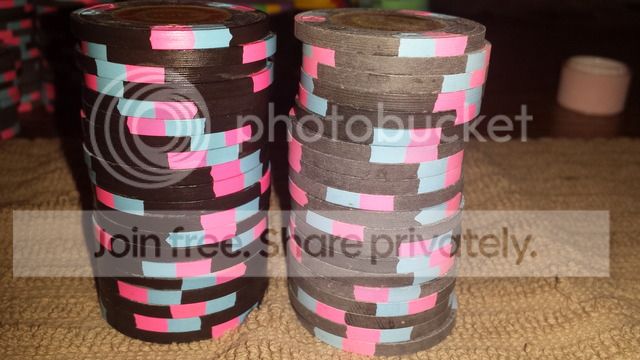


justsomedude
Royal Flush
NO ONE KNOWS SHT!
I think this sums it up most accurately.

Why wouldn't you oil the chips when the end result looks like this
Or this...?

I know I'm OCD and I have a feeling that a lot of people here are as well, so yup oil will always go on my new dusty chips. I don't have the patience to wait for natural oils when I know mineral oil will take care if it.
Last edited:
I know I'm OCD and I have a feeling that a lot of people here are as well, so yup oil will always go on my new dusty chips. I don't have the patience to wait for natural oils when I know MINERAL oil will take care if it.
FYP
... OK the next person to have custom CPC's delivered needs to order a few pizzas and bags of greasy potato chips , have a tournament and then post pictures of the chips 
We also will need to know how long before they smell rancid .
We also will need to know how long before they smell rancid .

Marius L
4 of a Kind
Why wouldn't you oil the chips when the end result looks like this
Agree. Ill oil all my chips if it makes them look like this. No question
^FYP. And sorry, I don't want random oils/sweat/whatever from from people's unwashed hands infiltrating my new raw chips. That's hardly 'proper'.unless you are OCD and wash your hands fifty times a day there is enough oil on your hands toproperlyoil 1-2 barrels of chips.
Even if one is doing it purely for aesthetic reasons, proper oiling with mineral oil ensures that the chips are treated uniformly and avoids the blotchy appearance associated with 'natural' oiling methods and the resulting uneven application on chip surfaces.I know I'm OCD and I have a feeling that a lot of people here are as well, so yup oil will always go on my new dusty chips. I don't have the patience to wait for natural oils when I know mineral oil will take care if it.
Not to mention that oiling with mineral oil avoids the whole issue of having your new chips sucking up sweat, food oils/grease, urine, mucus/germs, etc.

Similar threads


- Replies
- 30
- Views
- 4K